
This project uses unconventional approaches in several critical areas (scene graph injection, skin buffer manipulation, binary patches). External contributions could inadvertently break invariants [...]
Fallout 4 1.11.191 next-gen — multiplayer mod (FoM-lite framework). Solo-dev, evening project. Target: 10-player persistent-world survival MMO.

Six months in, solo, evenings, paid for out of my own pocket. The code is free forever under AGPLv3 and stays that way; a coffee goes to the API bill behind the reverse engineering and to the server the test clients run on. The longer write-up of where the project stands and why it is built this way is on Ko-fi.
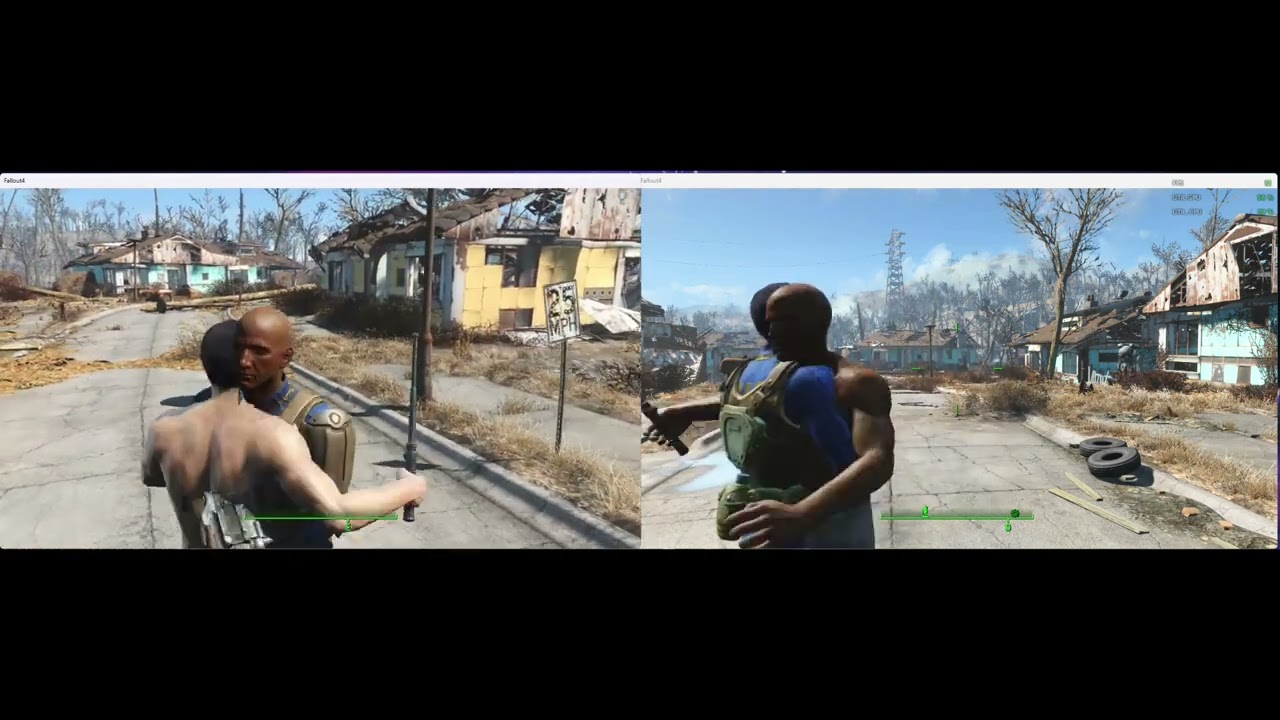
2 clients side-by-side, 1:52. Clothing and armor synced on the remote player, weapons with every attachment assembled by the engine exactly as equipped, and the full third-person animation set playing correctly on the ghost.
┌────────────────────────────────────────────────────────────────────────┐
│                     Python Server (asyncio UDP)                        │
│  authoritative state · keyed by placed form_id · validator             │
│  reliable channel (SACK + retransmit) · durable journal + snapshot     │
└─────────────────────────┬──────────────────────────────────────────────┘
                          │ binary protocol v43 (44B POS_BCAST · reliable channel · appearance recipes · world objects · session lifecycle · container reconvergence · checkpoints, custody and the player's record)
            ┌─────────────┼─────────────┐
            │             │             │
       ┌────▼─────┐  ┌────▼─────┐  ┌────▼─────┐
       │ Client A │  │ Client B │  │   ...    │
       │  FO4 +   │  │  FO4 +   │  │  Up to   │
       │ dxgi.dll │  │ dxgi.dll │  │  10      │
       │  proxy   │  │  proxy   │  │  peers   │
       └──────────┘  └──────────┘  └──────────┘
       Each client:
       - 1 LOCAL player (vanilla FO4 controls, full anim)
       - N GHOST bodies (1 per remote peer, native scene graph)
       - in-game overlay (ImGui on the game's own device): character
         creator, chat, nametags
| Path | Purpose |
|---|---|
fw_native/ |
C++ native client (dxgi.dll proxy + MinHook + scene graph injection) |
fw_native/src/native/ |
Strada B native injection (NIF loader, scene graph, ghost body) |
fw_native/src/hooks/ |
MinHook detours (kill, container, container menu, activation, pos poll, main_menu, worldstate, ownership, the loader flush) |
fw_native/src/persist/ |
L5: the save/load lifecycle, checkpoints and custody, the inventory capture, tap and restore, the character's numbers, the death flow, instance fingerprints |
fw_native/src/engine/ |
Engine calls (inventory, UI, world references) and the instance writers |
fw_native/src/net/ |
C++ port of Python protocol (byte-identical via static_assert) |
fw_native/src/render/ |
Present hook on the game's own swapchain + ImGui overlay (character creation, chat, nametags) |
fw_native/deps/ |
Vendored third-party deps (MinHook, Dear ImGui). Fetched locally, never committed |
fw_native/docs/ |
Internal docs + tools list |
launcher/ |
Python orchestrator (FO4 INI mgmt, side A/B startup, fw_config.ini) |
fw_launcher/ |
C++ launcher wrapper (FoM.exe) |
net/ |
Python server (asyncio UDP, validator, durable journal, snapshot v15, checkpoint custody, the respawn and the save rewriter) |
frida/ |
Frida JS scripts + Python attach helpers (RE / live tracing) |
re/ |
Reverse-engineering dossiers + IDA Python scripts |
tools/ |
Maintenance scripts: the crash campaign, the thread sampler, save inventory diff, forget a peer, rebook a checkpoint, remove a world object, Steam pin, Frida traces |
| Milestone | Status |
|---|---|
| B0 Networking + native client port | ✅ done — 196+ pytest, byte-identical protocol |
| B1 Container pre-mutation block | ✅ done — concurrent TAKE dup race closed; the blocking wait was replaced in v0.9.0 by optimistic ops with rollback |
B2 Launcher (FoM.exe) |
✅ done — drop-in for start_A.bat/start_B.bat. v0.6.4 adds --connect: pure JSON on stdout, banners on stderr, pass-through of --auth/--name/--client-id, the machine interface for the external server-browser launcher |
| P0 PIENUVO identity + auth (Ed25519 challenge-response, launcher vault, master server) | ✅ done (v0.6.4, 2026-08-04) — client id = fw + 13 hex of the pubkey hash, works on Steam and every non-Steam platform; signature binds the server address so a blob replays nowhere else; HELLO auth tail (wire v19), per-source challenge registry, vendored pure-Python ed25519, net/master/ discovery server. 405 pytest |
| B3 Auto-load save (delayed LoadGame via WndProc subclass) | ✅ done |
| B4 Worldstate sync (GlobalVar + QuestStage) | 🟡 GlobalVar shipped; QuestStage RE done, apply pending wire |
| M5–M6 Strada B ghost body (NIF native injection + textures) | ✅ done — body + head + hands textured, scene graph attached |
| M7 Ghost animations (local memcpy from PC tree) | ✅ superseded by M8P3 |
| M8P1 RE NiAVObject::Load3D | ✅ done — sub_1417B3E90 public API |
| M8P2 RE BSGeometry skin instance offsets | ✅ done — +0x140 confirmed |
| M8P3 Skin pipeline RE + per-bone pose replication | ✅ M8P3.23 — body+head+hands animated, see CHANGELOG.md |
| M8P4 First-person ghost animation | ✅ done (v0.6.5, 2026-08-06) — a sender in first person no longer freezes the remote ghost into a V/T-pose with grafted arms. The engine parks and deactivates the third-person animation graph on a camera switch, then copies the first-person skeleton over the third-person one every frame in a post-update hook; the DLL now drives the parked graph (revive, active-node refresh, forced flush/generate/apply), mirrors animation events onto it, raises the behavior's base-state trigger at wake-up, keeps it alive across camera switches, and suppresses the skeleton copy while driving. Pip-Boy re-parented to PipboyBone; pose channel made scale-immune. Residue: walk clip rate |
| B5 D3D11 custom render | 🗿 not needed — Strada B native injection replaced |
| B6 World-state sync expansion (composite epic; NPC pos/pose + combat split out to the N branch) | 🟡 6/13 wedges done (doors, cell-transitions, locks, terminals, world-object spawns, power armor); lights and time/weather parked, quests/companions/cell-cleared/one-shot loot/workshop open |
| ↳ B6.0 Door open/close sync | ✅ done — sub_140514180 Activate worker hook + dual-agent RE convergence, 30s demo, see CHANGELOG.md |
| ↳ B6.1 Cell-aware ghost transitions (interior / fast-travel / worldspace switch) | ✅ done (v0.5.2, 2026-05-08) — wire proto v11 ships cell_id in pos payloads; server validator accepts cross-cell teleport as baseline reset instead of rejecting it at the 2500 u/s speed gate. Receiver is a plain coord-bind: cross-cell distance (~120k units) puts the ghost outside the local frustum naturally; same-interior co-op puts both peers in the same coord frame. |
| M9 Equipment sync between peers (clothing + armor + weapon visual replication) | ✅ done (v0.5.1, 2026-05-08) — 5/5 wedges across all firearm families: pistols (10mm, handmade), sniper rifle, assault rifle, hunting rifle, combat shotgun, combat rifle, minigun, Fat Man, laser, plasma — all visible with mods on the remote ghost via engine BSConnectPoint pairing. Plus clothing + body cull + OMOD-driven ARMA tier + Vault Suit cycle stable. |
| ↳ M9.w1 Equip event detection + broadcast (sender hook OBSERVE-only) | ✅ done — ActorEquipManager::EquipObject/UnequipObject detour, EQUIP_OP/EQUIP_BCAST opcodes (protocol v6), [video coming soon] |
| ↳ M9.w2 Receiver-side NIF resolution + ghost attach + animation | ✅ done — TESObjectARMO struct walk, gender-aware path scoring (M3rd preferred over F/1stP), OMOD-driven priority extracted from BGSObjectInstance.extra+0x56 and shipped via wire (proto v10) so ghost picks the correct ARMA tier (Lite/Mid/Heavy). Engine helper sub_1404626A0 PrioritySelect algorithm reimplemented receiver-side. TTD-confirmed 2026-05-03. |
| ↳ M9.w3 Biped slot masking (hide ghost body parts under armor) | ✅ done — TESObjectARMO+0x1E8 bipedSlots bitmask, slot-3 BODY mask flips NIAV_FLAG_APP_CULLED on ghost's BaseMaleBody:0 BSSubIndexTriShape (cached at body inject via vtable RVA 0x2697D40 walker). Body hidden under Vault Suit / Power Armor / Synth Armor — no more z-fight. |
| ↳ M9.w4 Object Modification (BGSMod) sync — shoulder pads, weapon mods, paint variants | ✅ done (v0.5.1, 2026-05-08) — engine OMOD attacher sub_140434DA0 + BSConnectPoint pairing, sender-side 50ms auto re-equip cycle for off-by-one render lag. Every firearm family verified with mods (pistols, sniper, assault, hunting, combat shotgun, combat rifle, minigun, Fat Man, laser, plasma). Receivers, mags, scopes, suppressors, grips, barrels — all replicated. Demo. |
| ↳ M9.w5 Peer rejoin equipment-state push | ✅ done in v0.3.1 — PEER_JOIN trigger re-arms equip cycle (DONE→ARMED state transition), 1500ms delay, current outfit re-broadcast to newly-joined peer |
| ↳ B6.2 Lights toggle sync (lamps, lanterns, generators) | ⏳ — same Activate worker pattern as doors, formType filter on 0x20 LIGH |
| ↳ B6.3 Locks state sync (lockpicked → unlocked cross-client) | ✅ done (v0.5.3, 2026-05-08) — sender hooks ForceUnlock (sub_140563320) + ForceLock (sub_140563360); receiver applies via Papyrus ObjectReference.Lock binding (sub_141158640) with ai_notify=0 to skip minigame + key consumption. Wire proto v12 ships (form_id, base_id, cell_id, locked, ts). Covers doors, safes, weapon lockers, terminal-linked containers. Server persists per-(base, cell) state + replays on peer-join bootstrap. |
| ↳ B6.4 Terminals state sync (hacked / unlocked) | ✅ done (v0.5.6, 2026-05-10) — implicit closure: a successful terminal hack flips ExtraLock via the engine's ForceUnlock (sub_140563320), already detoured by B6.3. Broadcast and receiver-apply paths are identical to those for doors / safes / weapon lockers. Zero new code. Verified live on the Sanctuary terminal-house during the v0.5.6 cell-entry crash fix test pass. |
| ↳ B6.7 NPC dialogue state + faction joined | ⏳ — quest-stage adjacent; brainstorm §3.2 says 10 players = 1 entity, simplifies state |
| ↳ B6.8 Companion state (recruited / position) | ⏳ — companions are NPCs with extra ownership flag |
| ↳ B6.9 Cell-cleared status (no respawn after group clear) | ⏳ — cleared flag in cell extra-data, persisted server-side |
| ↳ B6.10 One-shot loot pickups (bobbleheads, magazines, holotapes, skill books) | 🟡 since v0.10.5 a vanilla pickup is relayed to the other clients as a disable (L6, R1b); the one-shot effect itself is not shared |
| ↳ B6.11 Time of day + weather sync | ⏳ — GlobalVar GameHour + Sky weather state |
| ↳ B6.12 Workshop / settlement build state sync | ⏳ — major epic; build/scrap/move workshop refs + furniture |
| ↳ B6.13 Power Armor frame + worn-state sync | ✅ closed (v0.7.6, 2026-09-16) — the frame rides the spawn rails (enter = despawn, exit = rebirth); pieces, OMOD upgrade levels, condition, core charge and paint jobs travel with the object and persist in a per-wid server ledger; replicas are stocked through the engine's own AddItem (sub_1411735A0) and AttachModToInventoryItem (sub_1411808F0) workers and the Health extra is created the way the engine does it; manual take/put and the power armor station (PowerArmorModMenu, polled while it lives) ship full state; frames are exempt from the loot layer and re-seat themselves after a station edit. The wearer's ghost is dressed and painted: Frame.nif plus the model OMOD meshes of every piece, material swaps read from the OMOD property records, on a ghost skeleton grafted with the 20 PA-only bones and retargeted to PA proportions while worn. Residue: fingers do not articulate. The frame lost when the wearer quits is closed server side in v0.8.0 (handed back to the world on leave, eviction and timeout) and still owes the live test with a client killed from the task manager |
| ↳ B6.14 World-object spawn sync | ✅ first version (v0.7.5, 2026-09-14) — PlaceAtMe detoured on both the Papyrus native and the console worker; server-assigned wid, JSON persistence, join bootstrap replay; receive-side placement = upright, ground snap, engine cell re-file, range-gated; lifecycle sweep reports deaths by wid, streaming losses re-queued, resurrection watch re-announces re-enabled refs; real removal idiom (RemoveReference + DestroyByHandle, no-save flag cleared first) |
| N NPC co-op combat (split out from B6.5 / B6.6 — grew into its own epic; my first iteration on the game's AI) | 🟡 N2 + N3 + N4 done; hardened in v0.6.3 (stale-pointer crash class closed via NiRefObject pinning, owner-state starvation fixed, locomotion relayed, 3 aggro defects fixed, deaths replayed to distant peers); v0.6.4 closed the respawn-load crash (freed-cell vcall in DetachReference: death release + engine passthrough in the death window + ownership quiescence, 8 deaths / 0 crashes). N1 still open: creature pose schema + post-mortem hardening. Scope still hostile raiders. |
| ↳ N1 NPC actor pos + pose sync (owner-driven) | 🟡 REOPENED partial (v0.6.2) — major hardening in v0.6.3 (2026-07-29): the owner-state batch was capped at 17 entries with no rotation, so 12 of 29 owned NPCs never received a position at all (measured drift where data DID arrive: 0.0 on 4,591/5,133 samples) — now multi-batch, everyone at full 10 Hz; the engine's NATIVE position (AI char-controller proxy) is snapped via sub_141894670 so it tracks the owner instead of diverging; locomotion is derived from the position delta and relayed (anim=1/2 → SpeedSampled 100/200), fixing the "slides like a log" mirrors; the bone cache is now refcount-pinned (+0x08) with a parent-detach probe, which closed the whole stale-pointer crash class. STILL OPEN: creature (non-humanoid) pose bleeds through a 1-name-match gate — a mole rat was seen stretched toward a map coordinate, needs a skeleton-schema gate, TODO in scene_inject.cpp; POST-mortem corpse hardening; leveled-list divergence means the same REFR can be a different NPC per client. |
| ↳ N2 NPC combat target + aggro + death sync (owner-driven threat table) | ✅ done (v0.6.0, 2026-06-01) — the Python server holds a threat table and elects the owner from whoever the raiders natively aggro (engine-native: noise / line of sight), with hysteresis anti-thrash; live aggro hand-off; bidirectional death-sync (corpse + ragdoll at the synced pos, either client's kill propagates). Scope: hostile raiders. v0.6.3 fixed three defects that made ownership effectively immovable: the engage signal was stamped once per NPC and decayed to zero forever (across 1,711 evaluations the challenger threat never exceeded 1.0, so only damage could move aggro — combat observes now refresh at 1.5 s); Actor+0x380 is an ObjectRefHandle and not a form id, so the "I am fighting this NPC" signal was a permanent false negative (now resolved through the handle table); and the proximity tie-break was mathematically inert (weight 1.0 vs a required delta of 3.0 — raised to 6.0 so it can break the engage tie two fighting clients produce). Deaths are also remembered server-side and replayed to peers that were out of range when they fired. |
| ↳ N3 Shared authoritative HP / damage | ✅ done (v0.6.2, 2026-06-06) — both clients deplete ONE server-held HP pool (damage captured at the engine HP-write funnel sub_140CC9650, FINAL post-resist; DLL floor-1 clamp stops either client soloing the kill; server fires the kill at pool=0). v0.6.2 closed it: the enemy-health HUD now shows the LIVE combined pool on both clients (the non-owner's local Health is driven to the pool fraction so the vanilla bar reads it — max = GetCurrent − cell, since the AVO GetMax leaf mis-reads), the aggro/first shot is no longer lost (claimed pre-tracking, server-buffered until the NPC registers), and multi-feeder + server-driven death are confirmed. The HUD bar is GREEN (non-hostile color — handy as a "this client has no aggro" tell); a RED color is TODO. Wire proto v18. |
| ↳ N4 Player death + respawn sync | ✅ done (v0.6.2, 2026-06-06) — a client's death is vanilla: it ragdolls + respawns at Sanctuary, and the raiders re-aggro the surviving client (the threat table re-elects on the death). v0.6.4 closed the death transition properly: the respawn-load crash is fixed (see N row), and the aggro flip is now a message, not a timeout: one reliable NPC_UNLOAD per owned NPC at death, so the raiders turn on the survivor within a frame instead of after 8 s. v0.10.0 moved the respawn to the server: a death is answered with the player's checkpoint moved onto the founder's respawn point and loaded once (11.7 s from 31,000 units away in the live test, against 2 to 6 minutes for a fast travel after the vanilla reload), the player healed, from an exterior or an interior, in power armour or not. |
| CG1 Character creation + appearance identity (new epic, my first custom in-game UI) | 🟡 v1 shipped (v0.7.0, 2026-08-12), deliberately unfinished. Forced first-entry ritual (server flag), sky staging + pinned auto-vanity camera, runtime catalogs (filtered head parts, 32 hair colours, 9 tint groups from race CharGenData), live editing of hair / eyes / beard / teeth / brows / skin tone / marks through the engine's own apply calls, recipe v2 (parts + tints, wire v21) stored per identity on the server, adopted at join and replicated onto the ghost with private composite textures and engine-computed body skin. Open: morph sculpting, body build, sex switch, Markings tab placement, per-peer ghost cache; the ImGui panel is a placeholder for the final UI |
| S1 Session lifecycle (join / leave / disconnect / rejoin / late join) | ✅ closed (v0.8.1, 2026-09-23) — phases 0-2 in v0.8.0: the ghost is born from PEER_JOIN and torn down on PEER_LEAVE instead of from a 30 s timer that never re-armed, a registry keyed by peer id replaces the single body pointer and the census of single-peer globals in the ghost path is empty; presence that outlives the session, resume tokens for a rejoin without the launcher, reject reasons on the wire, eviction with notice, a queued join bootstrap, a reconnection loop with backoff, a goodbye on ALT+F4. Phases 3-4 in v0.8.1: the worn outfit is read from the inventory and announced at every session start, global chat, nametags above the ghosts, the three reconnection holes closed with tests. Residue: matrix tests T4/T6/T7/T8 not run, a second remote ghost refused until a third client exists, a 100 ms race on a live container op, weapons not announced at session start |
| L Loot sync rework (containers, corpses, player inventory, world items) | 🟡 L1-L5 done — L1-L4 (v0.9.0, 2026-09-26): containers keyed by the placed reference, optimistic ops with rollback, the server view pushed and applied to every engine with a real-time menu redraw, corpses of placed NPCs. L5 (v0.10.0, 2026-10-02, and v0.10.5, 2026-10-20): no save or load the server did not command, a durable journal, mandatory login, the character in a checkpoint the server commands, keeps in custody and moves for the respawn and the first entry; since v0.10.5 a realtime record of the inventory by instance and of the character's numbers, given back after every load, the death crate with its markers, the crash campaign. Open: stage 5 (the save barrier, the .fos diff, fault injection), L6 beyond the Pip-Boy, L7 |
| ↳ L5 Player persistence (checkpoints, custody, the realtime record, death crates and markers) | ✅ done (v0.10.5, 2026-10-20) — a kill of the process loses nothing a checkpoint would have; the residuals are in the known limitations |
| ↳ L5 stage 5 Pollution and integration (save barrier, .fos diff, fault injection) | ⏳ next, after R3 (the player's last position made durable in the journal) |
| ↳ L6 World items | 🟡 Pip-Boy drops and pickups are ops of the player's record (v0.10.5); a vanilla pickup is relayed as a disable; open: arbitration between two pickers, the one-shot pickups |
| ↳ L7 Workshop, settlements and vendors | ⏳ parked by the sandbox-first decision: an empty, playable world first; vendors, companions and quest NPCs later |
| R Deterministic engine rolls (NPC looks, leveled loot, random weapon mods) | ⏳ parked epic — make the Creation Engine's random rolls deterministic instead of syncing every result, engine-native (no ESL, no Creation Kit) |
| B7 Rust server port | ⏳ |
Next, in order (2026-10-20): R3, the player's last position in the journal (half a day); L5 stage 5; L6; L7. Parked on purpose until the sandbox is playable: vendors, companions, quest NPCs, the RNG epic.
- Single-instance bypass (1-byte binary patch @ RVA
0xC2FB62) — runs 2 FO4 instances simultaneously on the same machine. Required for local multi-client testing without spinning up a second physical PC. The patch flips a NOP-equivalent on the singleton-check branch. apply_materialswalker discovery (sub_140255BA0) — the missing step for.bgsmmaterial resolution after standalone NIF load. Documented inre/stradaB_pink_body_solution.txt.- NIF loader public API (
sub_1417B3E90) — bypasses the broken cache wrapper that hangs with naive args. - Scene graph integration — depth occlusion, lighting, shadows free via
BSFadeNodeattachment toShadowSceneNode. - BSSkin::Instance layout fully RE'd —
bones_fbat+0x10,bones_priat+0x28,boneDataat+0x40,skel_rootat+0x48. Critical empirical finding via TTD:bones_pri[i]is NOT aNiAVObject**but a direct pointer-to-matrix cache (=bones_fb[i]+0x70). The GPU reads matrices via SRV indirection through this cache. Documented inre/M8P3_skin_instance_dossier.txt. - Moving a player inside a save — the server rewrites a
.fosthat the engine then loads as its own: the Player Location global (two spaces, the grid, a position local to the cell inside an interior), the player's move data, and for a player taken out of an interior the sky (mode 1 inside, 3 outside, followed by 29 bytes of outdoor state) and the acoustic space, transplanted from an exterior save.net/server/savepos.py. - Model-DB entry root shape — a NIF loaded with the fade-wrap flag is
stored with a
BSFadeNoderoot, and the engine's biped build silently produces no geometry from such an entry. The engine never loadsFrame.nifthrough the public loader, so a mod-created entry is the only one it finds. Biped loads must use the engine's own flags (0x2C). NiNode::AttachChildgrowth (sub_1416BE170/sub_1404E7B50) — a full children array is grown bySetSize, which frees the old buffer; file-loaded bones keep theirs in the loader arena, so the free faults. Pre-grow with the same pool allocation and never free the old block.- Power-armor pieces — the ARMA is a placeholder shared by every PA
model; the visible mesh is the model OMOD's
MODL, skinned to PA-only bones. Condition and core charge are one Health extra (0x25) on the inventory stack; the engine'sAddItem/AttachModToInventoryItemworkers and theExtraDataListadd idiom are all callable from the DLL. - Why leaving an interior takes minutes — every precombined mesh of the
destination cell is built on the renderer's resource-creation thread,
which spins while a Present is in flight; the loading screen presents at a
sync interval of 3 (the engine's own choice at 144 Hz), so each GPU
creation waits a vblank, about 850 meshes times several creations. Present
with interval 0 during a loader flush cuts the exit from minutes to
seconds.
RESEARCH_interior_loads.md(local),hooks/loader_flush_hook.cpp. - The inventory list's write lock — inside the engine's AddObject the list's writer bit is held on the calling thread, so a detour there reads nothing; the list is read a frame later, outside the lock.
- Native map markers from a mod — a MapMarker reference with its
MapMarkerData(SetMapMarkerData,sub_14027A680), its handle pushed into the player's own marker array (player+1848, under the global lock) and the map's rebuild event fired withtrue(sub_140D515B0): compass and Pip-Boy map both show it;AddToMapis never called, it sets fast travel.native/map_markers.cpp. - The character's numbers — XP is an actor value (list
sub_140263120- 208), the ActorValueOwner at
player+0x58(get, get base, mod base, set), perk points at+0xCF1with their setter,AddPerk/HasPerk, every PERK at the data handler.persist/player_stats.cpp.
- 208), the ActorValueOwner at
- The frame's body armour — entering a power armour frame the engine
force-equips one of seven
ArmorPoweredFrame*armours (slots 3, 4, 5 and 30, the Pip-Boy's); one of them left equipped on foot draws the Pip-Boy on a hidden wrist device. Never inventory. - The engine's own save, crash-proofed — a temporary reference in an
unloaded cell crashes the save (a null form id read inside
sub_140BF6DD0); references of ours are taken out of the world around every named save. The UI message queue (sub_141A89050) shows and hides a menu the way the engine does, used for the power armour HUD after a respawn.
Latest 3 patches summarized below. Full version history in CHANGELOG.md.
Tag v0.10.5, wire proto v43, server snapshot v15. The character no longer lives only in a checkpoint: the server keeps a record of the player's inventory, by instance, and of the character's numbers, kept current from the client's captures, and gives both back after every load, so a kill of the process loses nothing a checkpoint would have. A death leaves the whole inventory in a crate at the death point, marked on the compass and the Pip-Boy map ("LATEST DEATH", then "CORPSE #n"), and the player comes back on foot on the respawn point through one load, 6.8 s after the death in the last test; a death in power armour leaves the complete frame where the player fell. Other players show on the map. A crash campaign (twenty automatic cycles, five played) closed what a kill leaves behind: the exit checkpoint that crashed the engine's save, a death in an interior that fell back to an old checkpoint, a toolbox that came back full. And leaving an interior, one to four minutes in vanilla too, takes under seven seconds: the engine's resource thread waits a vblank per precombined mesh while the loading screen presents at a sync interval of 3, and the Present hook drops the interval during a loader flush. Detail in CHANGELOG.md.
Tag v0.10.0, wire proto v33, server snapshot v10. Stages 0 to 3 of the
inventory-persistence plan. Every save the engine attempts without the server's
command is refused by one lifecycle module in the DLL, the quicksave and quickload keys are dropped,
an uncommanded load is refused; the server appends every accepted change to
a durable journal and sends no reliable frame before its fsync; login is
mandatory, with a local key for the second test client. The DLL reads the
player's inventory the way the save writes it and taps the two engine
functions every inventory change goes through; items dropped from the
Pip-Boy exist for everyone. The character lives in a checkpoint the server
commands (at a quiet moment, on every exit, and the moment a player leaves
their power armour), keeps in custody and hands back at the next boot, on
any machine. A death is answered with the player's checkpoint moved onto the
founder's respawn point (server.ini): one load, no fast travel, the player
healed, from an exterior or an interior; a frame worn at the death goes
with the player or stays where they fell, never in two copies. A new
character starts on the same point. Detail in CHANGELOG.md.
Tag v0.9.0, wire proto v27, server snapshot v6.
- A container is its placed reference — the server keys containers by the placed reference's form_id instead of (base, cell), which merged twins. Runtime references are refused; a placed actor, whose base the engine generates per client, is identified by its form_id alone.
- Optimistic transactions with rollback — the engine applies at once and a refusal is undone on the main thread. No more 100 ms freeze per take; ops made during a drop are sent again, and a repeat gets the stored verdict.
- Every client converges on the server's view — pushed at the join and whenever a record changes, applied with AddItem and RemoveItem at scene settle, cell change, activation and after every op. The open container menu redraws in real time. A constant wrong since April kept the mod from ever building an untouched container's inventory list.
- Corpses — a dead placed NPC is a container, a living one is never aligned, and a new death makes a new corpse.
- Open — the player's own inventory is not persisted yet, which is the next step; randomness is per client; corpses of runtime-spawned NPCs stay local.
Full detail in CHANGELOG.md.
I've been waiting ~10 years for someone to ship Fallout 4 multiplayer. Existing efforts I'm aware of:
- Fallout Together — abandoned 2020, never reached stable bone replication.
- F4MP — paused / no animation system in the public state I last saw.
- Skyrim Together (predecessor for SkyrimSE) — got working but with desync issues that informed several of the architecture choices here.
This project takes a different architectural bet: native scene-graph
injection (BSFadeNode → ShadowSceneNode) plus per-bone joint
replication via the engine's own UpdateDownwardPass propagation,
instead of reimplementing skinning from scratch. I let the engine do
the heavy lifting (skin upload, GPU constant buffers, lighting, shadows
when fixed) and feed it joint matrices via memory writes that match
what its anim graph would have produced.
Whether this scales cleanly to 10 peers is an open question — current testing is 2-peer. The RE work for the 1.11.191 next-gen build (skin pipeline, pointer-cache layout, NIF loader API) is the contribution that should be most reusable for anyone else attempting the same thing.
Persistence (L5):
- A kill of the process inside an interior can bring the player back on another floor — a crash or a forced kill writes no checkpoint; the boot loads the last one and applies the server's last position blindly, in whatever cell is loaded, and with a checkpoint written inside the same interior the player can land elsewhere in it. Left open by decision: a clean restart fixes it. A clean quit, Alt+F4 and the task manager's "End task" all write an exit checkpoint and are not this case.
- A crash inside a dangerous window is not proven — the campaign killed the process at random moments, never on purpose while a checkpoint is being written, a transfer is half done or the death reload runs.
- Quick loot takes before the seed — with the HUD's quick loot the first take comes with the activation, one frame before the scan the server needs, so the server accepts that take on trust and never sees the pre-take content of a container nobody scanned. A container taken whole by one peer and scanned first by another, whose engine still has the save's content, is canonised by that scan: the first scan wins and other peers' ops are not reconciled.
- Two clients picking the same vanilla world item are not arbitrated — a loose item is keyed by (base, cell), not per reference; both can take it.
- Health, action points and rads are known to the server and not restored after a load — by decision; the engine and the checkpoint decide them, so quitting to heal works. Limb conditions, active effects and addictions are not even captured.
- Discovered places are the engine's — a discovery asks for a checkpoint, so a crash keeps it; a discovery in the window before that checkpoint is re-discovered (double XP), and a respawn from the genesis save, when no checkpoint on foot exists, starts every discovery over.
- An exit from power armour followed by a kill within a second puts the player back inside the frame — the exit is undone; another player entering the standing frame in that second would make two frames until one is left.
- A piece swapped from the Pip-Boy while inside a frame ends in the death crate, while the frame's ledger keeps the mounted one.
- When the server cannot move a checkpoint in time, a death falls back to the engine's reload and a teleport to the point; from a checkpoint inside an interior that teleport is skipped and the player stays inside.
- A deposit into an actor that the server refuses gives back the first stack of that item, not necessarily the one deposited.
- The exit after a long load crashes in the engine's allocator, after the exit checkpoint is written and recorded: nothing is lost, the process dies ugly.
Gameplay and sync:
- Tested with 2 peers — the peer-keyed registry landed in v0.8.0 and the ghost path holds no single-peer global any more, but a second remote ghost is still refused on purpose: that path has never been executed, because two clients means one remote peer each. It opens when there is a third client to prove it with. 10-peer scaling stays theoretical.
- Network rate-limited to 20Hz — works smoothly on LAN, untested over real-world internet routes; receiver-side interpolation between POSE_BROADCAST frames is open work.
- Inside an interior the ownership sphere sees the NPCs of other cells through their local coordinates: 180 owned NPCs in a cellar, hundreds cycling through assignment and release on the server. Since v0.10.5 a death releases them in one message; the churn itself is open.
- A weapon equipped when the save loads is not shown on the ghost until the peer equips or draws one — since v0.8.1 every piece of apparel worn at load is read from the inventory and announced at session start, so a ghost no longer starts naked; weapons are left to their own equip path on purpose and are not announced.
- Non-humanoid pose replication is unsafe — ownership and sync are no
longer limited to hostile raiders: the proximity sphere picks up any
actor within its radius, so settlers, animals and creatures all enter
the same pipeline. Pose replication, though, still assumes the human
skeleton, and the match gate accepts a single coincidental bone-name hit
— enough for a creature to be fed a human pose. A mole rat was seen with
part of its body stretched toward a fixed map coordinate. Raising the
threshold is not the fix (humanoid raiders themselves match only 4-7
joints); this needs a skeleton-schema gate, tracked in
scene_inject.cppatkNpcPoseMinMatch. - A raider occasionally doesn't join the fight on the non-owner — non-deterministic and rare. Aggro on noise / line of sight works as designed, but every so often one raider stays idle on the client that doesn't own it. Tolerated for now.
- Raider appearance diverges per client, loot converges — the Concord raiders are placed leveled refs, so the form_id matches across clients (pos / aggro / death sync all work), but each client's engine rolls a different NPC variant, outfit, weapon and mods from the leveled lists with its own RNG. Since v0.9.0 the loot converges: the first client to open a corpse or a container decides its contents, and every other client is aligned to it; since v0.10.5 a weapon or an armour piece keeps its mods and condition on the way (an instance travels with its descriptor). The appearance still diverges, and the corpse of a runtime-spawned NPC stays local. Parked for a dedicated epic that makes the engine's random rolls deterministic, staying engine-native (no ESL, no Creation Kit).
- A corpse's final position differs for a peer who arrives after the fight — the owner's final pose is not sent with the bootstrap.
- The character creation opens while the player is still landing at the first boot and freezes the falling pose until it closes.
Ghost and rendering:
- 1st-person walk cycle plays at the wrong rate — with the sender in first person the ghost now animates correctly (v0.6.5), but the walk clip runs at a rate unrelated to the ground covered until the sender switches view and back. The locomotion scalars the behavior scales its clips from are not written into a parked graph; deriving them from frame-to-frame displacement was tried and reverted (this drive does not run every frame, so the displacement spans gaps the delta time does not account for). The engine's own movement speed is the correct source. Workaround: one camera round-trip.
- Ghost body casts no shadow — the body is attached to the
ShadowSceneNodeand gets depth, lighting and occlusion from it, but it still does not appear in the shadow pass. Separate render-flag investigation, deferred. - No dedicated Pip-Boy pose on the ghost — the Pip-Boy mesh itself is
correct since v0.6.5 (parented to
PipboyBone, riding the forearm and animating with it), and the ghost no longer contorts while a peer has it open. What is missing is the gesture: vanilla has no third-person arm-raise for a remote player consulting a Pip-Boy, so the ghost shows its normal standing pose instead of the animation the peer sees. - A ghost built while its viewer is inside an interior shows its nametag and no body — the viewer who built it outside sees the peer; open.
- An appearance that reaches a ghost already alive dresses it again with the local player's borrowed parts, and the hair stays tied to the local player's head. The creation path avoids it (a ghost is built only after the peer's first position); a change of appearance would hit it.
- Power-armor headlamps do not light up on the ghost — the lamp mesh is an engine add-on point whose glow effect is bookkept globally, which is the crash class closed in v0.7.6; the ghost skips it.
- Fingers and toes do not articulate on ghosts — 53 of the 80 canonical joints never leave the sender's render tree, so hands and feet ride their parent joints without bending.
- A face master built while the local player wears power armor is not
validated — the master keeps pointers into the rig it was cloned from, and
v0.8.0 anchors them to a reference skeleton this DLL owns so a power-armor
rebuild cannot recycle them underneath. What is not checked is the master
itself: nothing refuses to park one whose bone names do not exist in the
human skeleton. The permanent tripwire is the
[face-slots]debug line.
Fallout4.exe 1.11.191 next-gen (December 2025).
ImageBase 0x140000000 (no ASLR in practice).
IDA Pro 9.3 used for static decomp; cached DB at re/Fallout4.exe.i64 (NOT
committed — proprietary format + size). Regenerate locally from your own
copy of Fallout4.exe.
Personal mod project. Not distributed. Requires owned copy of Fallout 4. No Bethesda IP committed to this repo (no game binaries, no BA2 contents, no decomp dumps — only my own analysis dossiers).
- RE dossiers (English, public):
re/M8P{1,2,3}_*.txt,re/M8_strategic_decision.txt— full reverse-engineering writeups for the player-creation pipeline (NIF loader API, BSGeometry skin instance layout, BSSkin pipeline + bones_pri pointer cache). - Full version history: CHANGELOG.md