





| ☁️ 2 clouds | 🏗️ 6 real projects | 🔁 Git-only rollback | 📡 27 assets streaming live |
|---|---|---|---|
| Azure (primary) + AWS | Terraform · K8s · GitOps | Verified with ArgoCD | Running on AKS |
DevOps Engineer with 2 years of hands-on experience in Azure infrastructure, Terraform, CI/CD, Kubernetes, and DevSecOps. At DevOps Insiders I work on Azure provisioning and pipeline automation.
On my own time I build things that actually run: a live AKS platform, a GitOps pipeline with Git-only rollback, a hub-and-spoke Azure network. I'd rather find where a design breaks on my own dime than on a client's.
Note
Every project below states its limits openly. Gaps are in each repo's roadmap, not hidden.
📍 Bengaluru, India · 🎓 BCA, Chandigarh Group of Colleges
DevOps Engineer · DevOps Insiders | Nov 2024 – Present
Industrial IoT monitoring application for a UK-based refinery client
- Built and maintained 6+ CI/CD pipelines on Azure DevOps and GitHub Actions across Dev, QA and Staging
- Provisioned Azure infrastructure with reusable Terraform modules and remote state; added 4 automated checks (fmt/validate, TFLint, tfsec, Checkov) to CI/CD
- Deployed containerized services on AKS with Docker and Helm; built Prometheus and Grafana dashboards for application, pod and infrastructure health
DevOps Engineer · Freelance | Jul 2026 – Aug 2026
Airflow Observability Pipeline
- Delivered a single-node Apache Airflow setup on Docker Compose (8 services), migrating from CeleryExecutor + Redis to LocalExecutor + PostgreSQL
- Built Airflow-to-Grafana monitoring with StatsD, Prometheus and Grafana, and verified ~129 airflow_* metrics
flowchart LR
    A["📝 Commit<br/>git · PR"] --> B["🔍 Validate + Scan<br/>terraform · pytest · Trivy"]
    B --> C["📦 Build<br/>Docker · GitHub Actions"]
    C --> D["🚀 Reconcile<br/>Argo CD · AKS · Helm"]
    D --> E["📊 Observe<br/>Prometheus · Grafana"]
| Cloud & IaC |  Azure |
 AWS |
 Terraform |
|||
| Containers |  Docker |
 Kubernetes |
 Helm |
|||
| CI/CD & GitOps |  GitHub Actions |
 Azure DevOps |
 Argo CD |
|||
| Observability |  Prometheus |
 Grafana |
||||
| Systems & Code |  Linux |
 Bash |
 Python |
 FastAPI |
 PostgreSQL |
 Git |
| DevSecOps | Trivy tfsec TFLint Checkov SonarQube Infracost |
|||||
Azure is my primary cloud (AKS in production work); AWS at project level.
Terraform → ACR → AKS, end to end, serving real traffic.

▶ Click the screenshot to watch the deployment walkthrough
27 simulated industrial assets stream telemetry every 5 seconds into a live dashboard with 3D digital twins and real-time health scoring. Terraform provisions Azure, GitHub Actions builds images into ACR, and Kubernetes manifests roll the workloads onto AKS.
⚙️ Key engineering decisions
- Terraform
for_eachover anenvironmentsmap: one module tree renders dev, staging, and prod - Remote state bootstrapped from a separate
state-infrastructure/stack - ACR
admin_enabled = false: identity-based auth only - Ingestion and query split into separate services so each scales on its own
- Path-filtered image builds: a frontend commit doesn't rebuild the backend
Honest scope: Terraform workflow is plan-only; DB credentials are inline. Key Vault, PVC, and Ingress/TLS are on the roadmap.





Every release scanned, costed, reviewed and approved before it reaches Prod.
flowchart LR
    U([Operators]) -->|HTTPS| AG["Application Gateway<br/>TLS + WAF"]
    AG --> FE["2 x Frontend VMs"]
    FE --> ILB["Internal<br/>Load Balancer"]
    ILB --> BE["2 x Backend VMs"]
    BE -->|private endpoint| DB[("PostgreSQL<br/>Flexible Server")]
    BE -.-> KV["Key Vault"]
    ADM([Admins]) -->|Bastion| FE

    classDef edge fill:#fde8e8,stroke:#c53030,color:#5a1313;
    classDef tier fill:#e8f1fb,stroke:#0078D4,color:#003a70;
    classDef data fill:#e6f6ec,stroke:#2f855a,color:#14452f;
    class AG edge;
    class FE,ILB,BE tier;
    class DB,KV data;
A three-tier Azure platform for an Industrial IoT monitoring system in petroleum refineries. I designed the Landing Zone with modular Terraform and built the Azure DevOps pipelines that ship infrastructure and application (frontend, backend, database) through Dev, Test and Prod with manual approval gates.
⚙️ Key engineering decisions
terraform validate, tfsec, TFLint and Infracost all run before apply, then plan review and manual approval- Infrastructure and application CI/CD are separate, so neither waits on the other
- Build once, promote the same artifact through Dev → Test → Prod with approval gates
- Private endpoints for PostgreSQL, Azure Bastion for admin access, Key Vault for secrets
- Liquibase for versioned database migrations, with SonarQube quality checks on application code
Honest scope: the application code was written by the wider dev team; this repo covers the platform and delivery pipelines.


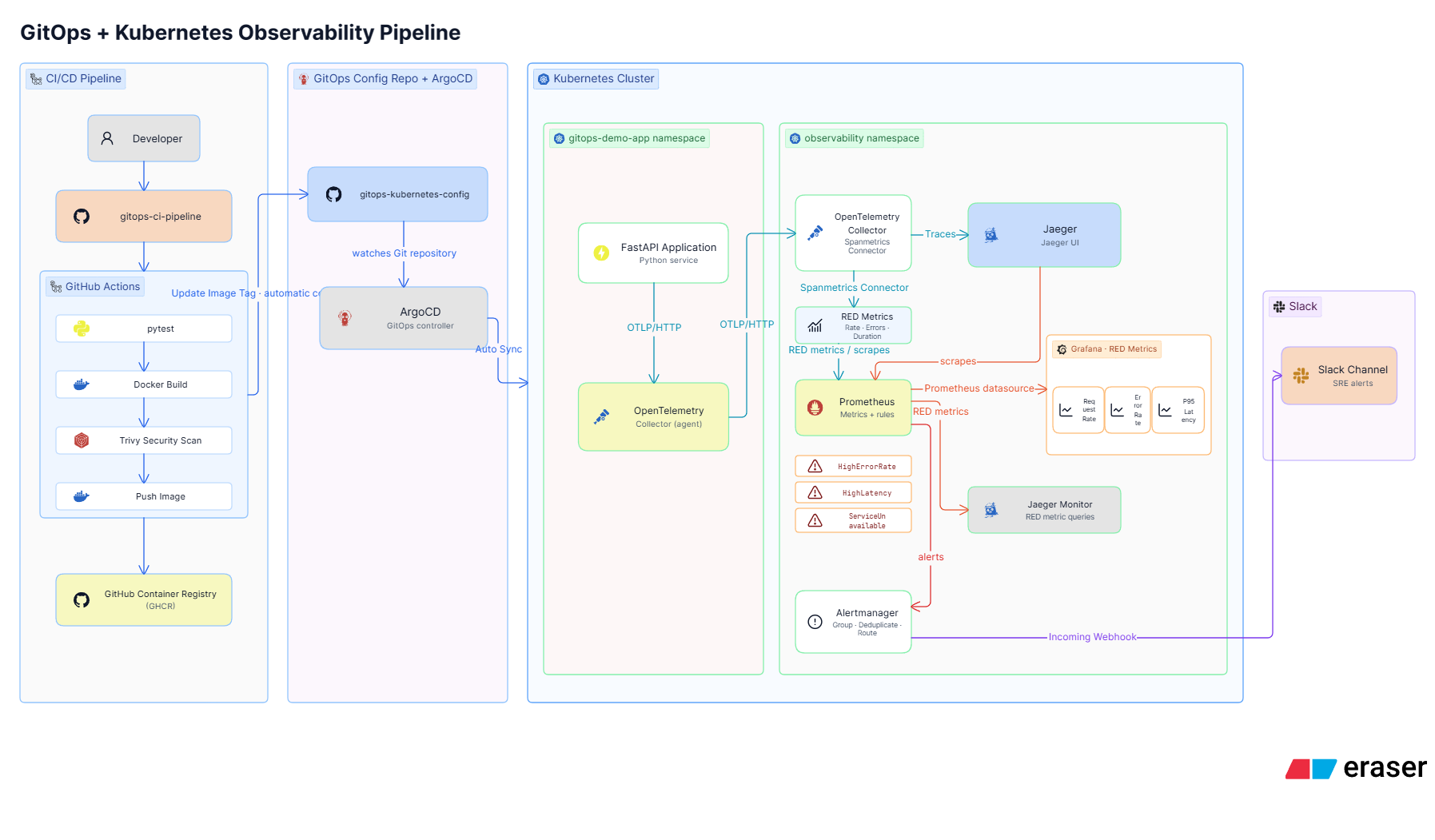
CI builds and scans. Argo CD deploys. CI never touches the cluster.
flowchart LR
    Dev(["👤 Developer"]) --> T

    subgraph CI["⚙️ CI · GitHub Actions"]
        T["pytest"] --> B["Docker build"] --> S["Trivy scan"] --> P["Push to GHCR"]
    end

    subgraph CD["🔁 GitOps · Argo CD"]
        G[("gitops-kubernetes-config")] --> A["Argo CD<br/>auto-sync"]
    end

    subgraph K8S["☸️ Kubernetes"]
        APP["FastAPI app"] --> OT["OpenTelemetry<br/>Collector"]
        OT -->|traces| J["Jaeger"]
        OT -->|RED metrics| PR["Prometheus"]
        PR --> GF["Grafana"]
        PR --> AM["Alertmanager"] --> SL["Slack alerts"]
    end

    P -->|update image tag| G
    A -->|reconcile| APP

    classDef ci fill:#e8f1fb,stroke:#2088FF,color:#003a70;
    classDef gitops fill:#fdeee6,stroke:#EF7B4D,color:#5a2a13;
    classDef obs fill:#e6f6ec,stroke:#2f855a,color:#14452f;
    class T,B,S,P ci;
    class G,A gitops;
    class OT,J,PR,GF,AM,SL obs;
A two-repo GitOps setup. One repo owns the FastAPI app and its pipeline; the other owns the desired cluster state that Argo CD reconciles. The app is instrumented with OpenTelemetry, so every deploy ships with traces, RED metrics, dashboards and Slack alerts.
⚙️ Key engineering decisions
- Trivy
CRITICALgate hard-fails the build before an image reaches GHCR - Two separately scoped tokens, so GitHub Actions never holds cluster credentials
- Argo CD with
automated,prune, andselfHeal - Rollback is a
git revert: nokubectl rollout undo, no Argo CD CLI - OpenTelemetry Collector fans out traces to Jaeger and metrics to Prometheus
- Alertmanager rules for high error rate, high latency and service unavailable, routed to Slack
- Non-root container on
python:3.12-alpine
Honest scope: runs on a local Kind cluster; only dev is fully automated.
🖼️ Full architecture diagram





Hub-and-spoke, deny-by-default, no public IPs on compute.
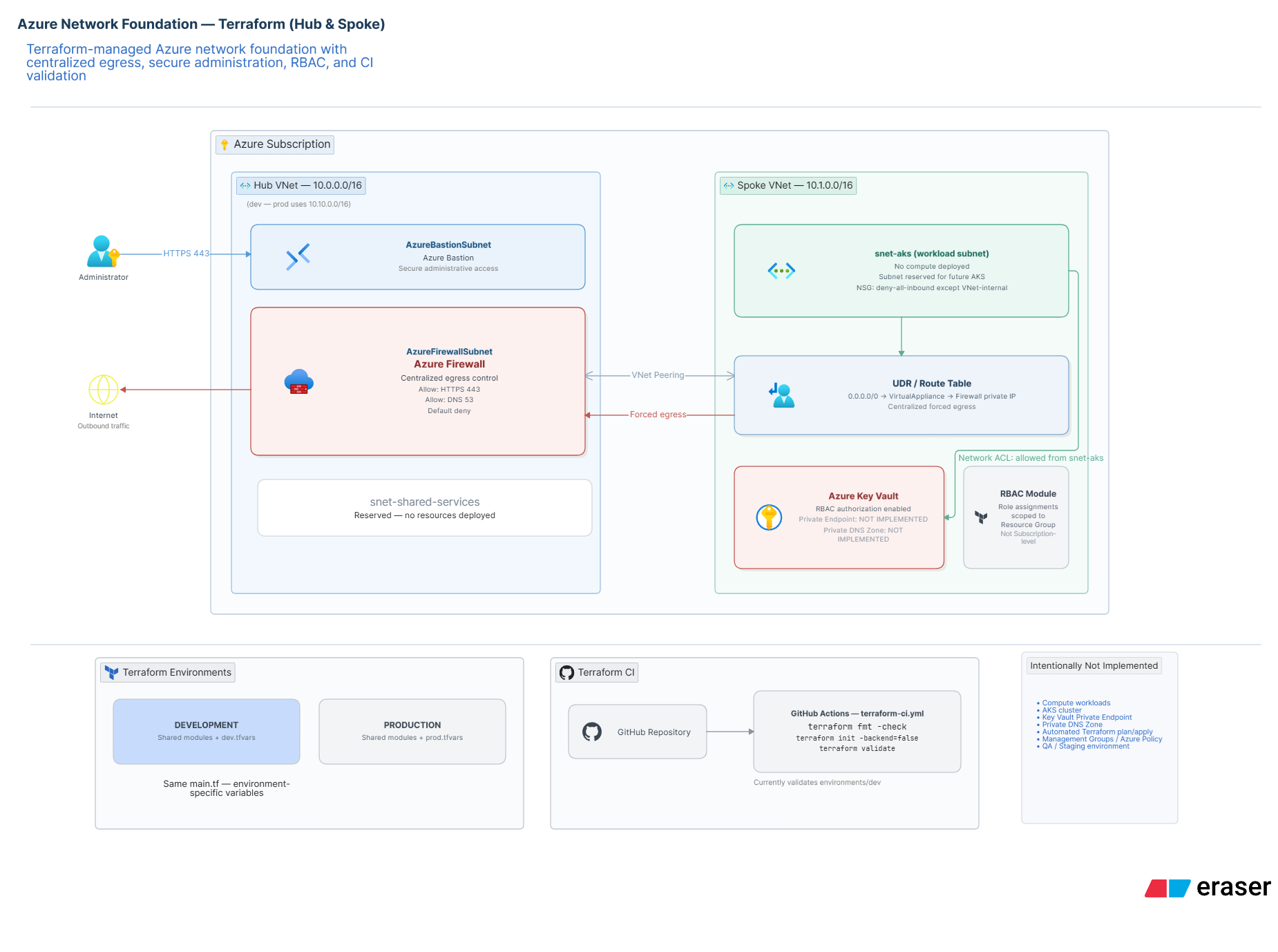
A hub VNet (Firewall and Bastion), a spoke VNet with a deny-by-default NSG and an AKS-ready subnet, and an RBAC-authorized Key Vault. Deployable to dev and prod from one Terraform configuration.
⚙️ Key engineering decisions
- Route table forces AKS egress through the Firewall, so its rules are actually enforced
- RBAC scoped to the resource group, not the subscription, to limit blast radius
- Explicit
DenyAllInboundinstead of relying on platform defaults - Azure Bastion instead of a jump box
- Key Vault via RBAC and network ACL: a documented trade-off against Private Endpoint
Honest scope: sandbox-scale, not a full landing zone. CI runs fmt, init, and validate only.


|
☁️ AWS Landing Network 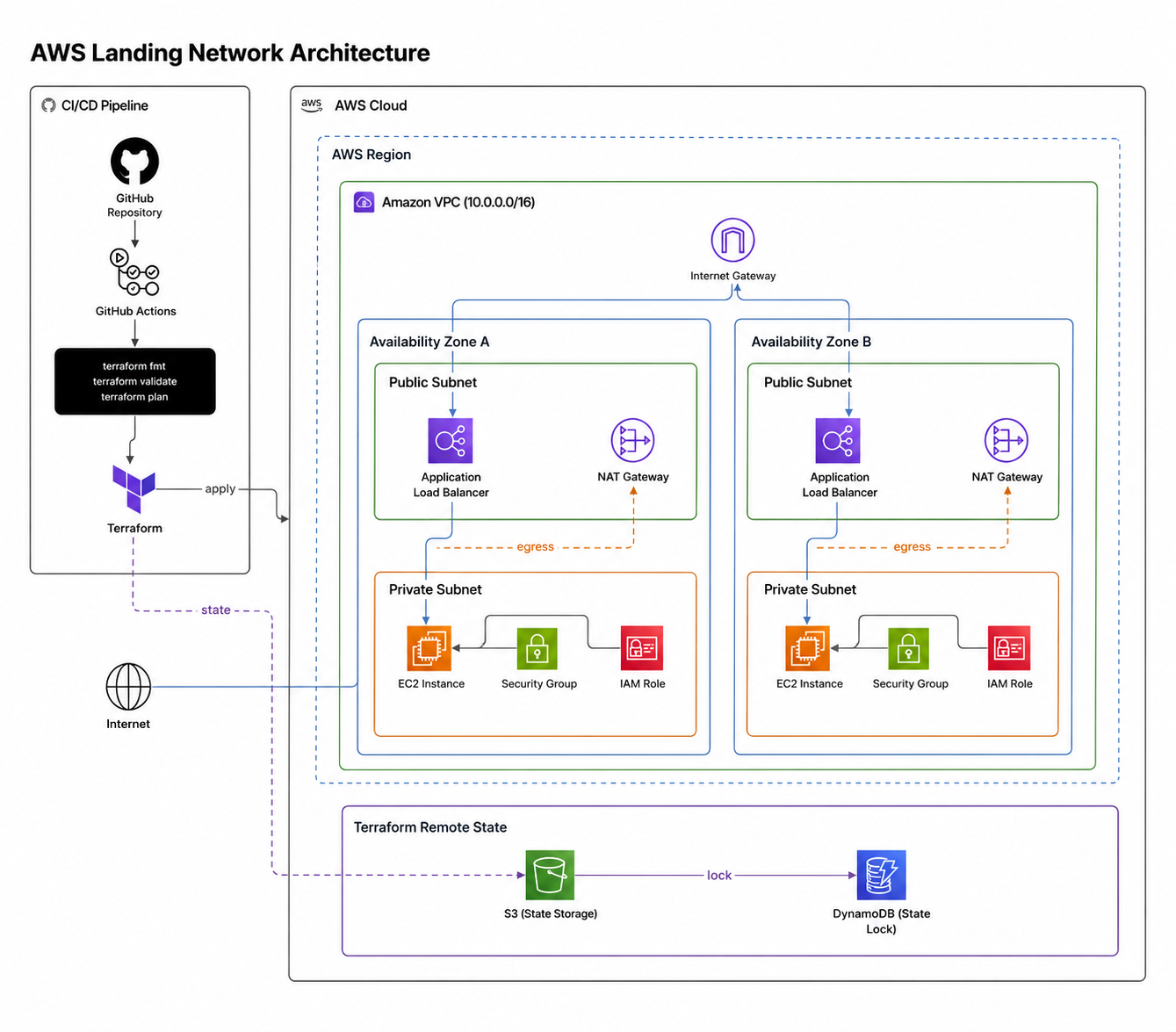
The Azure private-compute pattern, rebuilt on AWS. Multi-AZ VPC, ALB-fronted EC2 in private subnets, outbound via NAT, and remote state in S3 with DynamoDB locking. Every PR runs |
📊 Airflow Observability Pipeline 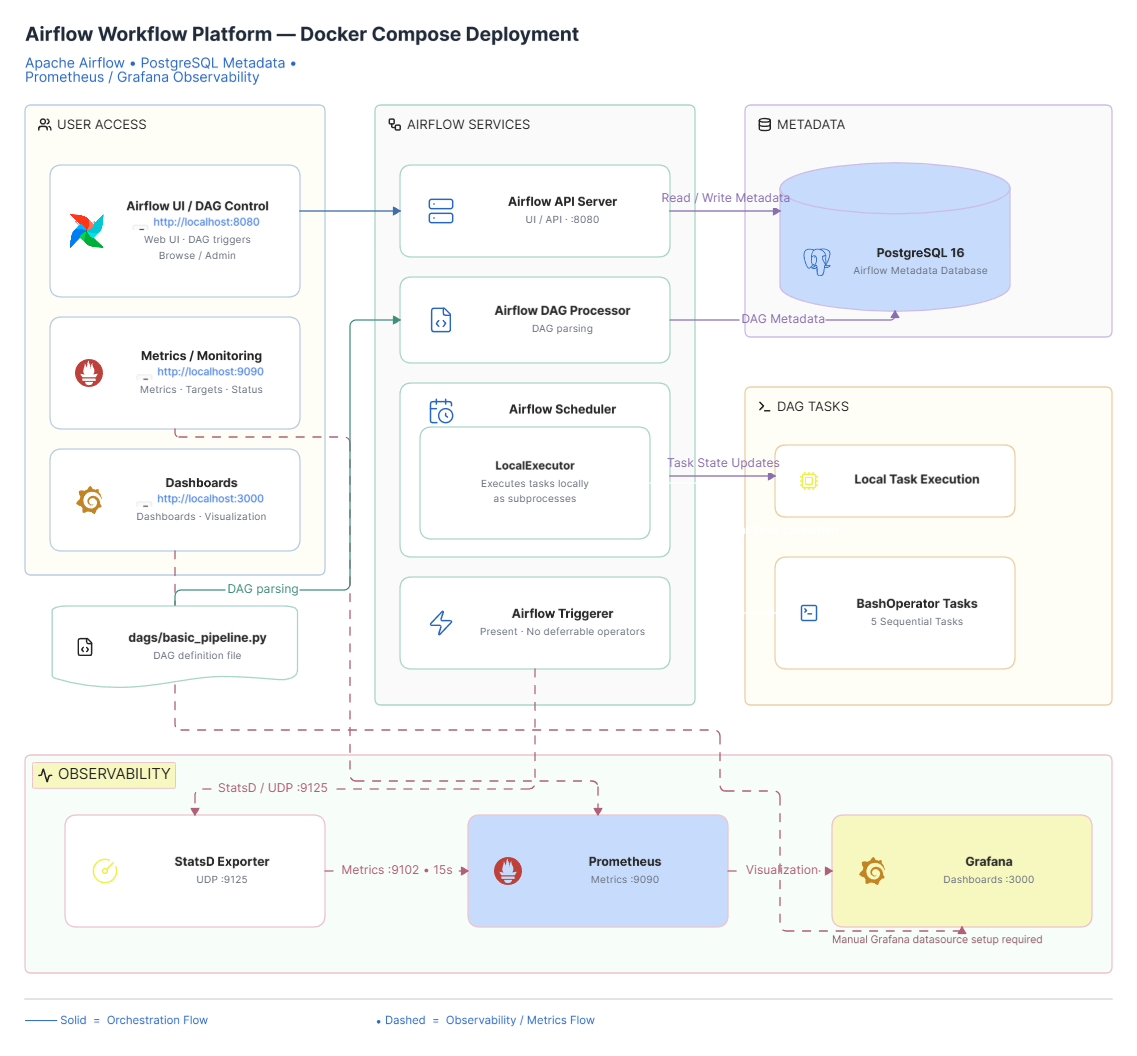
Client project. I re-architected Airflow's Celery/Redis setup into a single-node |
Automate · Secure · Observe · Repeat
|
Reproducible infrastructure Modular Terraform with remote state, no manual console changes |
Pipelines with security gates Trivy, tfsec and Checkov run before anything ships |
Git-based rollbacks Argo CD reconciles from Git, rollback is a git revert
|
|
Kubernetes delivery AKS deployments with Docker and Helm |
Observability Prometheus and Grafana dashboards for apps, pods and infrastructure |
Azure-first cloud Landing zones, hub-and-spoke networking, AWS at project level |


Happy to compare notes on Terraform module design, AKS networking, or GitOps patterns.


