
Unified Linux Incident Response Toolkit -- Audit, Acquire, Analyze.









The name SYNTROPY comes from the concept of syntropy -- the opposite of entropy.
Entropy pulls things toward disorder and chaos. Syntropy is the reverse: it's the tendency toward order, organization, and structure in complex systems. That idea maps directly onto what this toolkit does. When a system is under attack and you're staring at forensic chaos, SYNTROPY gives you the methodology and tools to restore order, keep a clear chain of evidence, and bring structure to the investigation.
SYNTROPY is an open-source forensic ecosystem made up of three specialized tools that work together to audit, acquire, and analyze volatile evidence on Linux systems under investigation.
It's built for Blue Team and DFIR people who need the full memory incident response lifecycle:
| Phase | Tool | Objective |
|---|---|---|
| 1. Triage | LinSpec | Audit kernel hardening posture and identify vulnerabilities |
| 2. Acquisition | S.I.R.E.N | Extract memory dump with awareness of the active security profile |
| 3. Analysis | K-Scanner | Detect processes with suspicious RWX memory regions in real-time |
What sets it apart:
- Read-only operation -- no process injection, no kernel modification
- Audit-aware acquisition -- adapts strategy based on active kernel protections
- Cryptographic integrity -- SHA256 on every forensic artifact
- Pure C99 (LinSpec, K-Scanner) and Bash (S.I.R.E.N) -- minimal dependencies (system libraries + ncurses for K-Scanner TUI)
LinSpec checks critical Linux kernel security parameters in real-time and classifies each one as PASS, WARN, or VULN.
What it looks at:
| Category | Parameters |
|---|---|
| Memory | ASLR, devmem_restrict |
| Kernel | kptr_restrict, dmesg_restrict, kexec_load_disabled |
| CPU | Spectre v2, Meltdown |
| Network | BPF JIT hardening, TCP syncookies, IP forwarding |
| System | Ptrace scope, user namespaces, protected symlinks/hardlinks |
Output: Structured report.json + report.csv, consumed by S.I.R.E.N so it can adapt its acquisition strategy.
sudo ./linspec

# Sample output:
# [ 01 ]  MEMORY   >  ASLR                              [+] [   PASS   ]
# [ 02 ]  KERNEL   >  Kernel Pointer Restriction        [-] [   VULN   ]
# [ 12 ]  MEMORY   >  DMA Restriction                   [+] [   PASS   ]
# [ 15 ] CPU > Meltdown Mitigation [+] [ PASS ]Volatile memory acquisition tool that's context-aware. It reads LinSpec's report.json and figures out the best extraction strategy automatically.
Operation modes:
| Option | Function | Source | Risk |
|---|---|---|---|
| 1 | Map physical RAM | /proc/iomem |
None |
| 2 | Verify extraction pipeline | /proc/version |
None |
| 3 | Live memory extraction | /dev/mem (falls back to /proc/kcore) |
Low |
| 4 | Advanced forensic bypass | /proc/kcore (ELF-aware) |
Low |
How it adapts based on audit data:
- If
kptr_restrict > 0it reads audit params for context - If
spectre_v2 = 0ormeltdown = 0it warns about side-channel leaks during extraction
Key improvements:
- ELF-aware
/proc/kcoreextraction via Python (parses PT_LOAD segments) - Non-interactive CLI mode:
--quick,--full,--test,--output - Post-dump content validation (entropy sampling, magic bytes)
- Persistent operation logging for chain of custody
sudo ./src/siren.sh          # Interactive menu
sudo ./src/siren.sh --full # Headless full acquisitionScans every active process by reading /proc/[PID]/maps looking for memory regions with RWX (Read-Write-Execute) permissions. That's a direct violation of the W^X (Write XOR Execute) principle.
What it catches:
ANON_BLOB-- Anonymous executable region (shellcode, fileless malware)JIT_ENGINE-- JIT compilation (Firefox, Python, Node.js, Discord)VOLATILE_FS-- RWX in/tmpor/dev/shmPROC_STACK-- Executable stack (exploit or insecure configuration)
sudo ./kscanner --json > alerts.jsonInteractive TUI: Navigate processes, view real-time alerts, press ENTER to extract suspicious regions with automatic SHA256, strings, and hexdump generation.
- Full memory incident response lifecycle (triage -> acquisition -> analysis -> remediation)
- Audit-aware acquisition strategy that adapts to kernel hardening level
- Real-time RWX memory violation detection
- Interactive ncurses-based forensic TUI
- Automatic SHA256 integrity chain on every artifact
- JSON/CSV structured forensic reports
- Modular architecture -- each tool works standalone or integrated
- Minimal dependencies (C99 + system libraries; ncurses for K-Scanner TUI)
 PHASE 1 -- LinSpec Audit:

 [ 01 ]  MEMORY   >  Address Space Layout Randomization     [+] [   PASS   ]
 [ 02 ]  KERNEL   >  Kernel Pointer Restriction             [-] [   VULN   ]
 [ 05 ]  NETWORK  >  BPF JIT Compiler Hardening             [!] [   WARN   ]

 PHASE 2 -- S.I.R.E.N Acquisition:

 --> Address: 00001000-0009efff : System RAM [VALID]
 --> Address: 00100000-5aaeafff : System RAM [VALID]
 [+] Extraction via /proc/kcore -- 32 GB acquired
 [+] SHA256: a1b2c3d4e5f6...

 PHASE 3 -- K-Scanner Analysis:

 PID    PROCESS              STATUS          MAP_ADDR
 53220  suspicious-process   RWX ALERT       3ed35854000
 1132   python3              RWX ALERT       7fc163862000
 1426   Xorg                 SAFE            n/a
The three tools talk to each other through a shared forensic protocol -- report.json.
LinSpec talks to:
/proc/sys/sys/devices
The audit flow goes like this:
- Collect kernel security parameters
- Normalize and classify values
- Compare against a hardened baseline
- Assign PASS / WARN / VULN states
- Export
reports/report.json
S.I.R.E.N talks to:
/proc/iomem/dev/mem/proc/kcore
Acquisition flow:
- Load LinSpec audit data (
report.json) - Map valid System RAM regions via
/proc/iomem - Pick the acquisition source (
/dev/memor/proc/kcore) - Dump physical memory with SHA256 integrity chain
- Generate forensic report and manifest
K-Scanner talks to:
/proc/[PID]/maps/proc/[PID]/mem
Analysis flow:
- Parse
/proc/[PID]/maps - Identify memory permissions (R / W / X)
- Detect RWX violations (W^X policy breach)
- Classify process behavior
- Dump suspect regions with strings and disassembly
Orchestration layer:
syntropy-run.sh-- Runs the full pipeline (LinSpec + S.I.R.E.N + K-Scanner) in one commandsyntropy-bind.sh-- Creates a unifiedsyntropy_report.jsonfrom all tool outputssyntropy-scan-offline.sh-- Offline analysis of existing .bin dumps
git clone https://github.com/jeffersoncesarantunes/SYNTROPY.git
cd SYNTROPY
cd LinSpec && make && cd ..
cd K-Scanner && make && cd ..
chmod +x S.I.R.E.N/src/siren.sh S.I.R.E.N/tools/kcore_extract.py
sudo ./scripts/syntropy-run.sh
Prerequisites: gcc, make, ncurses, binutils, coreutils, bash 4.x+, python3, root privileges.
make build                       # Build all C components (LinSpec + K-Scanner)
make test                        # Run ShellCheck on all scripts
make docker                      # Build Docker image
make install                     # Install system-wide
make clean                       # Clean build artifacts
You can also build individual components:
cd LinSpec && make && cd ..      # LinSpec only
cd K-Scanner && make && cd ..    # K-Scanner only
chmod +x S.I.R.E.N/src/siren.sh S.I.R.E.N/tools/kcore_extract.py  # SIREN (scripts, no compilation)
YARA is a pattern-matching engine that K-Scanner's --yara flag and the offline scanner use to identify malware signatures in memory dumps. You only need it if you're using the --yara option in syntropy-run.sh or syntropy-scan-offline.sh.
sudo pacman -S yaraINCIDENT DETECTED
│
▼
┌──────────────────┐
│ PHASE 1: TRIAGE │
│ LinSpec │ < 1 second
│ "Is the kernel │
│ hardened?" │
└────────┬─────────┘
│
▼
┌──────────────────┐
│ PHASE 2: ACQUIRE │
│ S.I.R.E.N │ < 5 minutes
│ dump memory with │
│ integrity chain │
└────────┬─────────┘
│
▼
┌──────────────────┐
│ PHASE 3: ANALYZE │
│ K-Scanner │ < 30 seconds
│ "Who has RWX?" │
│ + strings + hex │
└────────┬─────────┘
│
▼
┌──────────────────┐
│ REPORT │
│ Evidence with │
│ cryptographic │
│ chain of custody │
└────────┬─────────┘
│
▼
┌──────────────────┐
│ REMEDIATE │
│ Automated │
│ remediation │
│ suggestions │
└──────────────────┘
cd LinSpec
sudo ./linspec
The report lands in reports/report.json and S.I.R.E.N picks it up automatically in the next phase.
Things to watch for:
kptr_restrict = 0-- Kernel pointers visible (information leak)devmem_restrict = 0--/dev/memunrestricted (extraction risk)spectre_v2 = 0-- CPU vulnerable to Spectrebpf_jit_harden = 0-- BPF JIT without hardening
cd S.I.R.E.N
sudo ./src/siren.sh
You get an interactive menu:
1) Map Physical Memory (iomem)
2) Verify Extraction Pipeline
3) Live Memory Extraction (/dev/mem)
4) Advanced Forensic Bypass (kcore)
5) Exit
Note: Option 3 attempts /dev/mem but modern kernels restrict it via CONFIG_STRICT_DEVMEM — the tool falls back to /proc/kcore automatically.
Recommendation: Option 4 (kcore) uses Python to parse PT_LOAD segments from /proc/kcore (ELF-aware extraction), producing a dump with segment metadata. It's the most complete and stable method.
Non-interactive usage:
sudo ./src/siren.sh --quick                    # 100MB triage
sudo ./src/siren.sh --full --output /evidence/ # Full + custom dircd K-Scanner
sudo ./kscanner # Interactive TUI mode
sudo ./kscanner --json # JSON export (headless)
sudo ./kscanner --csv # CSV export (headless)TUI controls:
- Navigate processes with arrow keys
- Red rows = RWX ALERT
- Green rows = SAFE
- Press ENTER on a suspicious process to extract the RWX region
- Press Q to exit
Live regex search across process memory:
sudo ./kscanner --live <PID> "<regex>"Incident response on Linux has always lacked a unified, audit-aware forensic pipeline. Most tools work in isolation -- your kernel auditor can't talk to your memory acquirer, and your RWX detector has no idea what the system's protection state looks like.
SYNTROPY fixes that by:
- Feeding kernel audit data directly into acquisition decisions
- Giving you a repeatable three-phase forensic workflow
- Keeping cryptographic integrity at every stage
- Running with zero system modification
- Letting you collect evidence in production without downtime
It turns raw kernel telemetry into a structured, court-ready forensic chain.
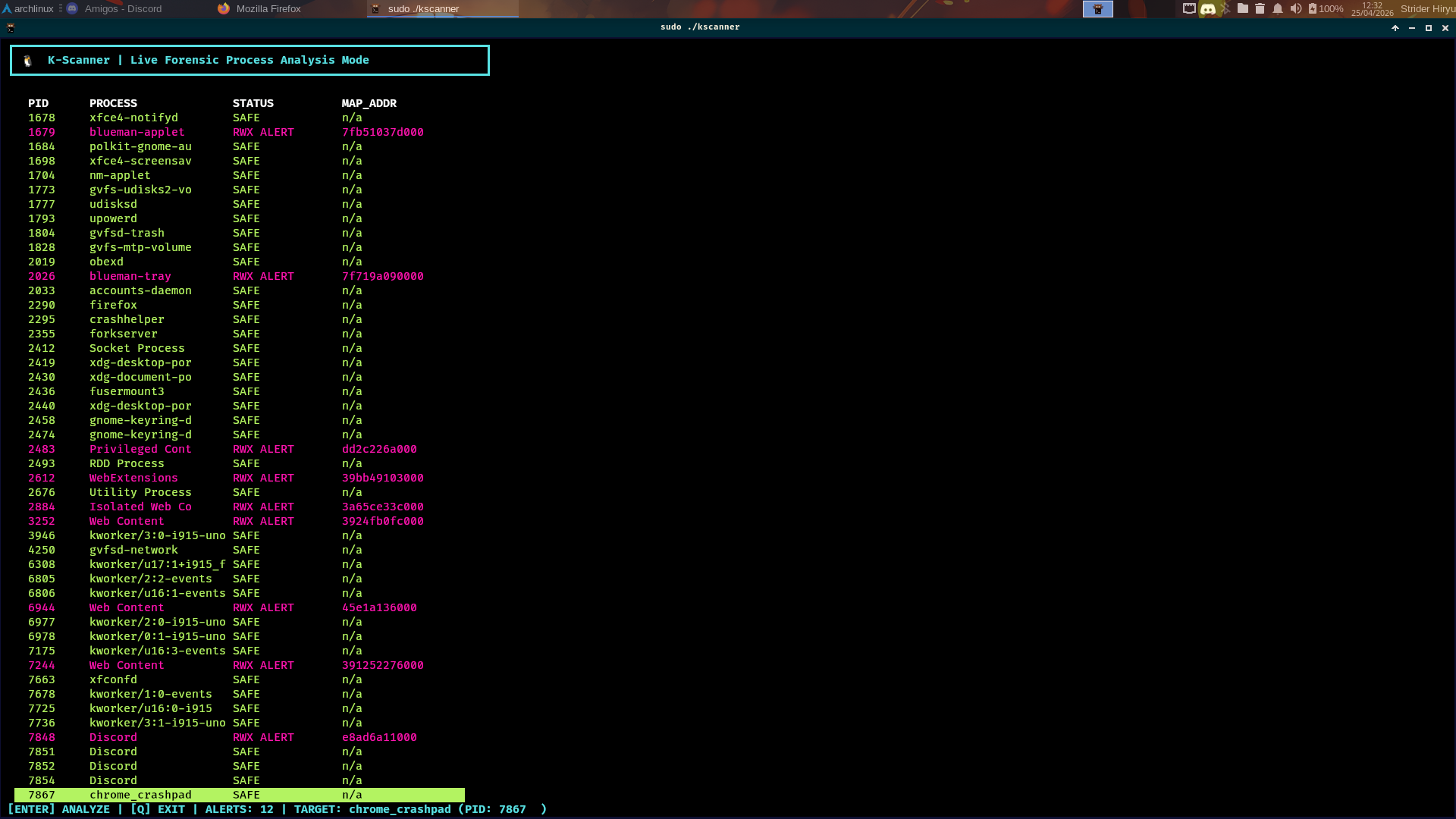 1 - Live forensic mode identifying RWX memory regions across active processes.
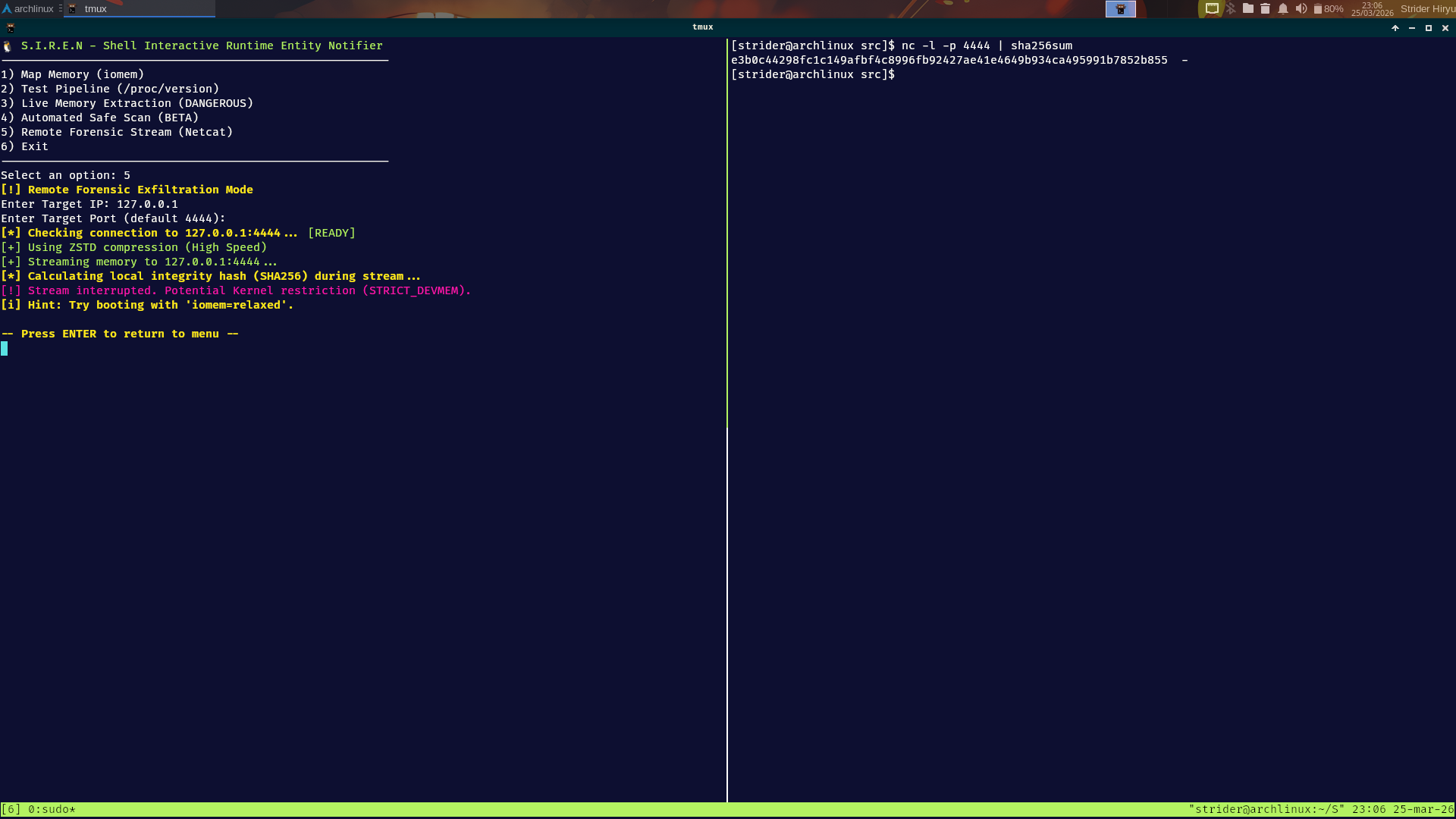 2 - Full memory acquisition with integrity verification and structured reporting.
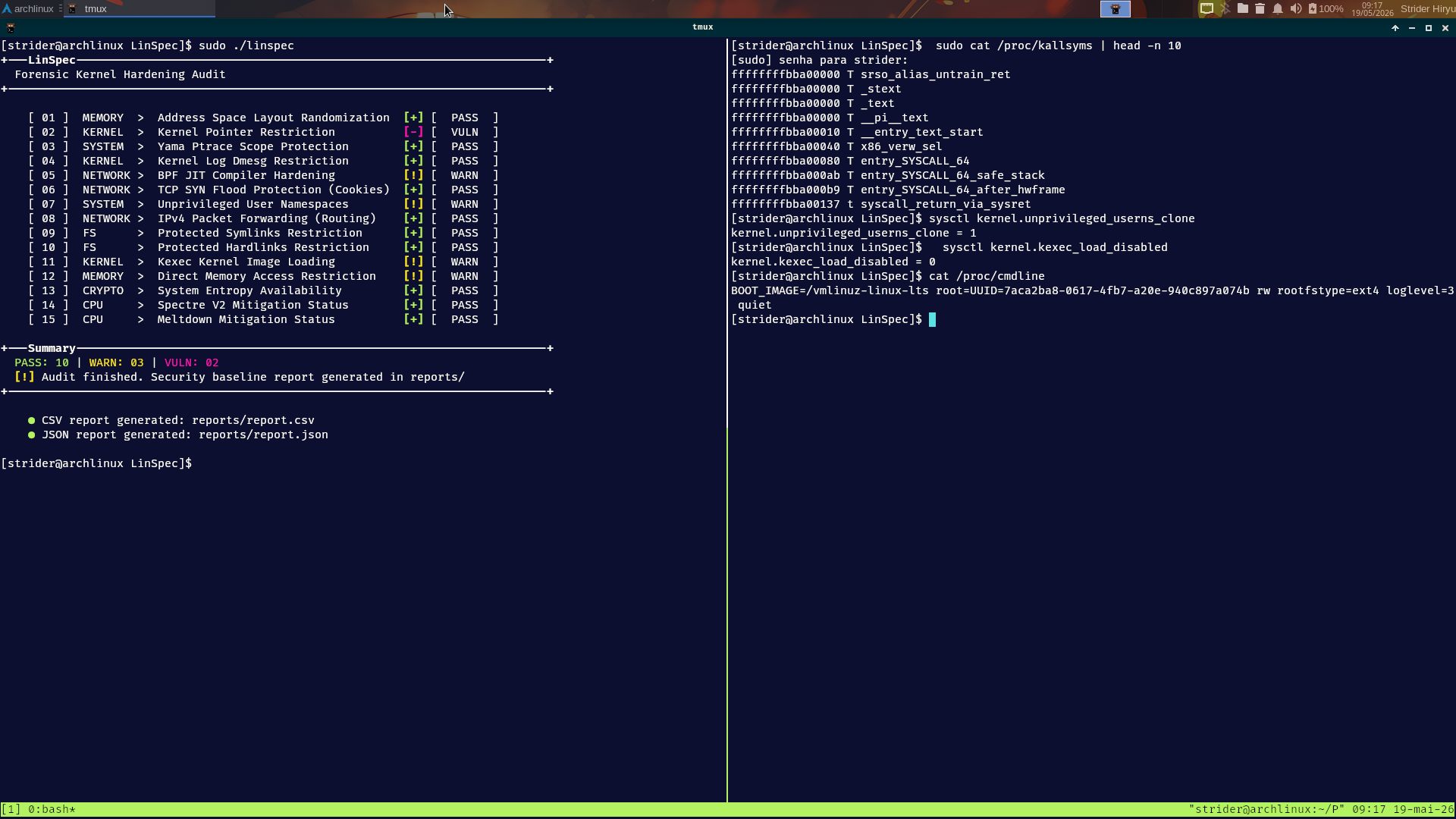 3 - Cross-validation of kernel audit results against live system state.
SYNTROPY was designed for live-response environments where you can't afford to break things:
- Read-only across all components
- No process injection or kernel modification
- Audit-aware fallback between memory interfaces
- Cryptographic integrity on every forensic artifact
- Graceful failure when access is restricted
- Zero-downtime evidence collection in production
- Linux Kernel 5.x or newer
- gcc, make
- ncurses (K-Scanner)
- binutils, coreutils
- Bash 4.x+
- Root privileges
- UTF-8 compatible terminal
SYNTROPY comes with four automation scripts that wire together the full forensic pipeline between LinSpec, S.I.R.E.N, and K-Scanner. They're all independent -- they call the existing tool binaries and process their output without modifying anything in the tools themselves.
# Full pipeline: audit -> acquire -> analyze -> unified report
sudo ./scripts/syntropy-run.sh

# With YARA rule analysis
sudo ./scripts/syntropy-run.sh --yara /path/to/rules.yara

# Custom output directory
sudo ./scripts/syntropy-run.sh --out /evidence/case-001Runs the complete three-phase workflow and collects everything into a single case directory:
sudo ./scripts/syntropy-run.sh [--yara <rules.yara>] [--out <dir>]Here's what it does:
- LinSpec -- kernel hardening audit (
report.json) - S.I.R.E.N -- memory acquisition via kcore (
.bindump) - K-Scanner -- live RWX analysis (
kscan_results.json) - syntropy-bind.sh -- unified report generation
- syntropy-remediate.sh -- automated remediation plan (
remediation_plan.json)
All artifacts go under /tmp/syntropy/FOR-<timestamp>/ (or wherever --out points):
<case-root>/
├── audit/
│   └── report.json
├── acquire/
│   ├── full_scan_*.bin
│   └── report_*.json
├── analyze/
│   └── kscan_results.json
├── syntropy_report.json        <- unified forensic report
└── remediation_plan.json       <- remediation suggestions
Merges LinSpec, S.I.R.E.N, and K-Scanner output into one forensic report with chain of custody:
# From a completed case directory
./scripts/syntropy-bind.sh /tmp/syntropy/FOR-20260603-153022/

# With explicit acquisition hash
./scripts/syntropy-bind.sh /tmp/syntropy/FOR-20260603-153022/ a1b2c3d4e5f6...
Generates syntropy_report.json with:
- Full audit-acquire-analyze timeline
- RWX alert summary and process list
- SHA256 chain of custody
- Artifact paths for all phases
Generates a structured remediation_plan.json from all tool findings, organized by severity and grouped by source (LinSpec sysctl, K-Scanner process, SIREN acquisition). Supports interactive and automated modes:
# Generate remediation plan from a completed case
./scripts/syntropy-remediate.sh /tmp/syntropy/FOR-20260603-153022/

# Auto-detect latest case and apply remediations interactively
sudo ./scripts/syntropy-remediate.sh --apply

# Apply remediations without confirmation prompts
sudo ./scripts/syntropy-remediate.sh --apply --force
What it suggests:
| Source | Finding Type | Suggested Action |
|---|---|---|
| LinSpec | Kernel param VULN/WARN | sysctl -w <param>=<value> |
| K-Scanner | RWX ALERT process | kill -9 <PID> or docker stop <container> |
| K-Scanner | Shellcode / YARA match | Isolate binary, quarantine |
| S.I.R.E.N | Integrity failure / missing dump | Re-acquire or investigate |
Additionally generates a persistent_block that can be pasted into /etc/sysctl.d/99-syntropy-hardening.conf for boot-persistent kernel hardening.
Under the hood:
- LinSpec findings processed by
LinSpec/remediator(C) -- readsreport.json, outputs structured JSON - K-Scanner findings parsed from
kscan_results.json-- each RWX ALERT becomes a kill/quarantine suggestion - SIREN findings verified via SHA256 integrity check on acquired dumps
Scans a raw memory dump (.bin) without needing the original system. Uses the same toolchain K-Scanner relies on (sha256sum, strings, hexdump, objdump, yara):
# Basic analysis
./scripts/syntropy-scan-offline.sh dumps/binaries/full_scan_20260603.bin

# With YARA rules
./scripts/syntropy-scan-offline.sh dumps/binaries/full_scan_20260603.bin --yara rules/malware.yara
Artifacts generated alongside the dump file:
full_scan_20260603.bin          <- original dump
full_scan_20260603.bin.sha256   <- integrity hash
full_scan_20260603.bin.strings.txt  <- extracted strings
full_scan_20260603.bin.hex.txt  <- hexadecimal preview
full_scan_20260603.bin.disasm.txt   <- x86-64 disassembly
full_scan_20260603.bin.yara.txt <- YARA rule matches (if --yara)
SYNTROPY/
│
├── K-Scanner/
│   ├── src/
│   │   ├── core/
│   │   ├── modules/
│   │   └── utils/
│   ├── include/
│   ├── scripts/
│   ├── docs/
│   └── Makefile
├── LinSpec/
│   ├── src/
│   ├── include/
│   ├── docs/
│   └── Makefile
├── S.I.R.E.N/
│   ├── src/
│   ├── lib/
│   ├── tools/
│   ├── dumps/
│   ├── docs/
│   └── .gitignore
├── scripts/
│   ├── syntropy-run.sh
│   ├── syntropy-bind.sh
│   ├── syntropy-remediate.sh
│   └── syntropy-scan-offline.sh
├── .gitmodules
├── LICENSE
├── README.md
└── SECURITY.md
Each subdirectory keeps its own docs and an independent Makefile. You can use the toolkit as an integrated suite or grab individual tools.
- Core Language: C99 (LinSpec, K-Scanner)
- Acquisition Layer: Bash 4.x+ (S.I.R.E.N)
- Data Sources:
/proc,/sys,/dev/mem - Interface: ncurses TUI (K-Scanner)
- Hashing: SHA256
- Forensic Reports: JSON / CSV
- Build System: GNU Make
- Target: Linux Kernel 5.x / 6.x
- Kernel hardening audit engine (LinSpec)
- Audit-aware adaptive memory acquisition (S.I.R.E.N)
- Real-time RWX detection with ncurses TUI (K-Scanner)
- Cryptographic integrity chain (SHA256)
- JSON/CSV structured forensic reporting
- Cross-tool integration via
report.jsonprotocol - Live regex memory hunting (K-Scanner
--live) - eBPF real-time RWX telemetry (K-Scanner
--bpf) - Disassembly and shellcode pattern detection (K-Scanner)
- YARA rule-based scan (K-Scanner
--yara) - Container-aware deep inspection (K-Scanner)
- Automated orchestration pipeline (
syntropy-run.sh) - Unified forensic reporting (
syntropy-bind.sh) - Offline dump analysis (
syntropy-scan-offline.sh) - Automated remediation suggestions (syntropy-remediate.sh)


