




Open-source data platform for small teams.
Dango gives you a complete data stack — ingestion, warehouse, transformations, and dashboards — with the operational machinery a self-assembled stack doesn't have: sync queue management, lock recovery, empty-replace protection, schema drift detection, credential health checks, and backups. It combines dlt for data loading, DuckDB as the analytics database, dbt for SQL transformations, and Metabase for dashboards. One install, one command to start.
Upgrading from v0.1.x? v1.0.0 is a complete rewrite. Back up your data and run
dango initto create a new v1 project. See the migration guide for details.

Prerequisites: Python 3.10-3.13, Docker (for Metabase and dbt docs)
macOS / Linux:
curl -sSL https://getdango.dev/install.sh | bashWindows (PowerShell):
irm https://getdango.dev/install.ps1 | iexPrefer pip?
mkdir my-project && cd my-project
pip install getdango
dango init
dango start
Open http://localhost:8800 to see your data platform.
For detailed installation instructions, see the documentation.
dango mcp setupConnects Claude Code, Cursor, or Windsurf to your project over MCP — your agent can set up sources
(credentials stay in your .env, never in the chat), sync, build and document dbt models, manage
schedules, check PII findings and schema drift, diagnose failures, and run read-only queries with
PII columns masked. Remote tools default to a dry run. See the
full guide for the complete tool reference
and worked examples.
- 35 data sources — Stripe, Google Sheets, Google Analytics, Shopify, PostgreSQL, MySQL, CSV, REST APIs, and more
- Auto-generated dbt models — staging models created automatically when you add a source
- Data catalog — browse tables, columns, and profiling stats; view dbt lineage and test results
- Web dashboard — monitor syncs, manage sources, and view platform health
- Metabase integration — dashboards and SQL queries, auto-configured and ready to use
- Scripts — schedule custom Python scripts alongside your syncs; runs on a schedule with access to your warehouse
- Cloud deployment — deploy to DigitalOcean or any server with
dango deploy - Authentication — admin login, user management, 2FA, API keys
- Schema drift detection — get alerted when source schemas change
- PII scanning — detect personally identifiable information across your tables
- Notebooks — Marimo notebooks connected to your DuckDB warehouse
- Monitoring — metric tracking with trend detection and drill-downs
- Scheduled syncs — cron-based scheduling with queued execution, retry, and timeout handling
- Webhooks — Slack notifications for sync results and alerts
- Local backup —
dango backuplists and restores local project backups - File watcher — auto-sync when CSV files change on disk
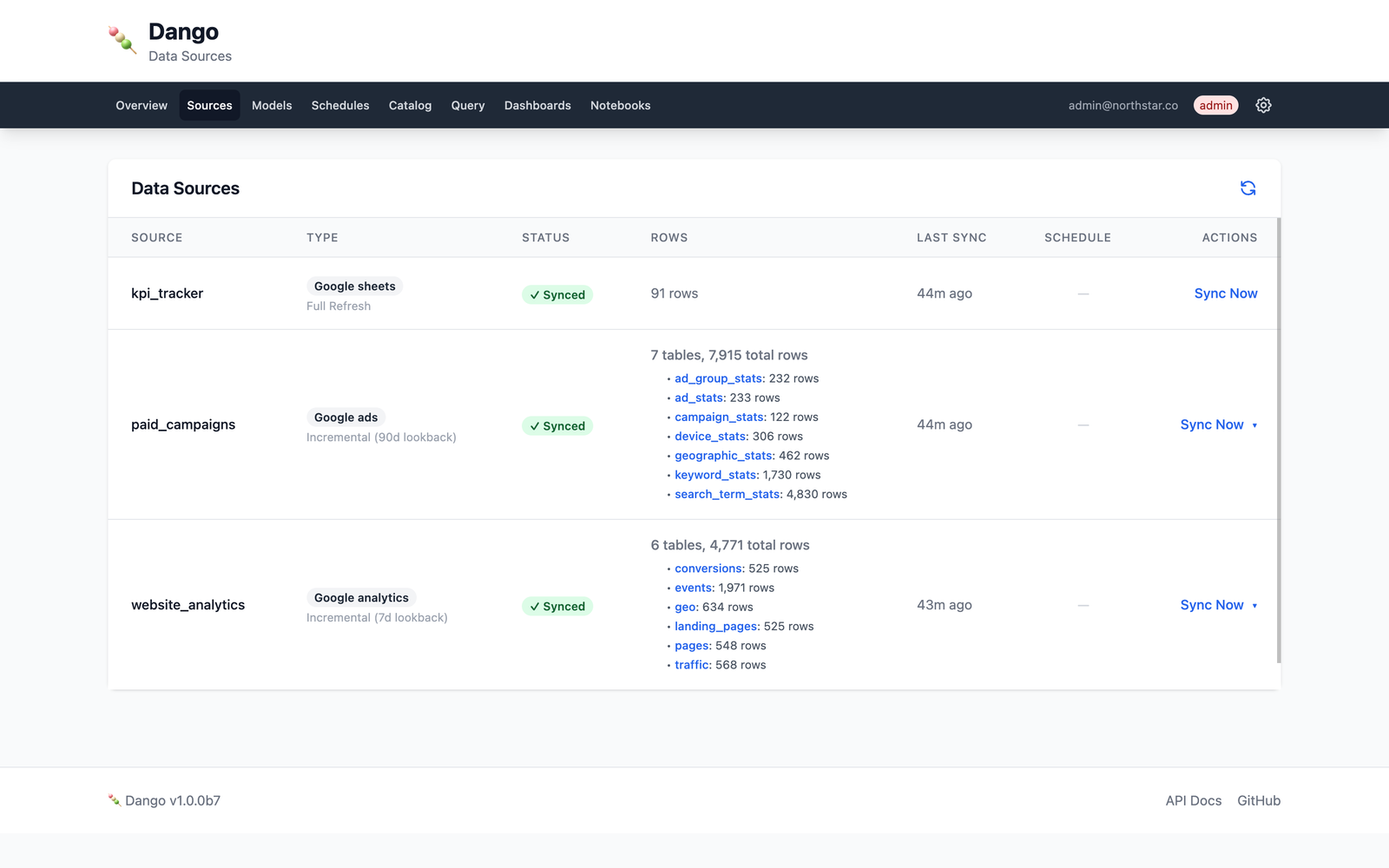
Data Sources page — monitor syncs, row counts, and schedule status for all your data sources.
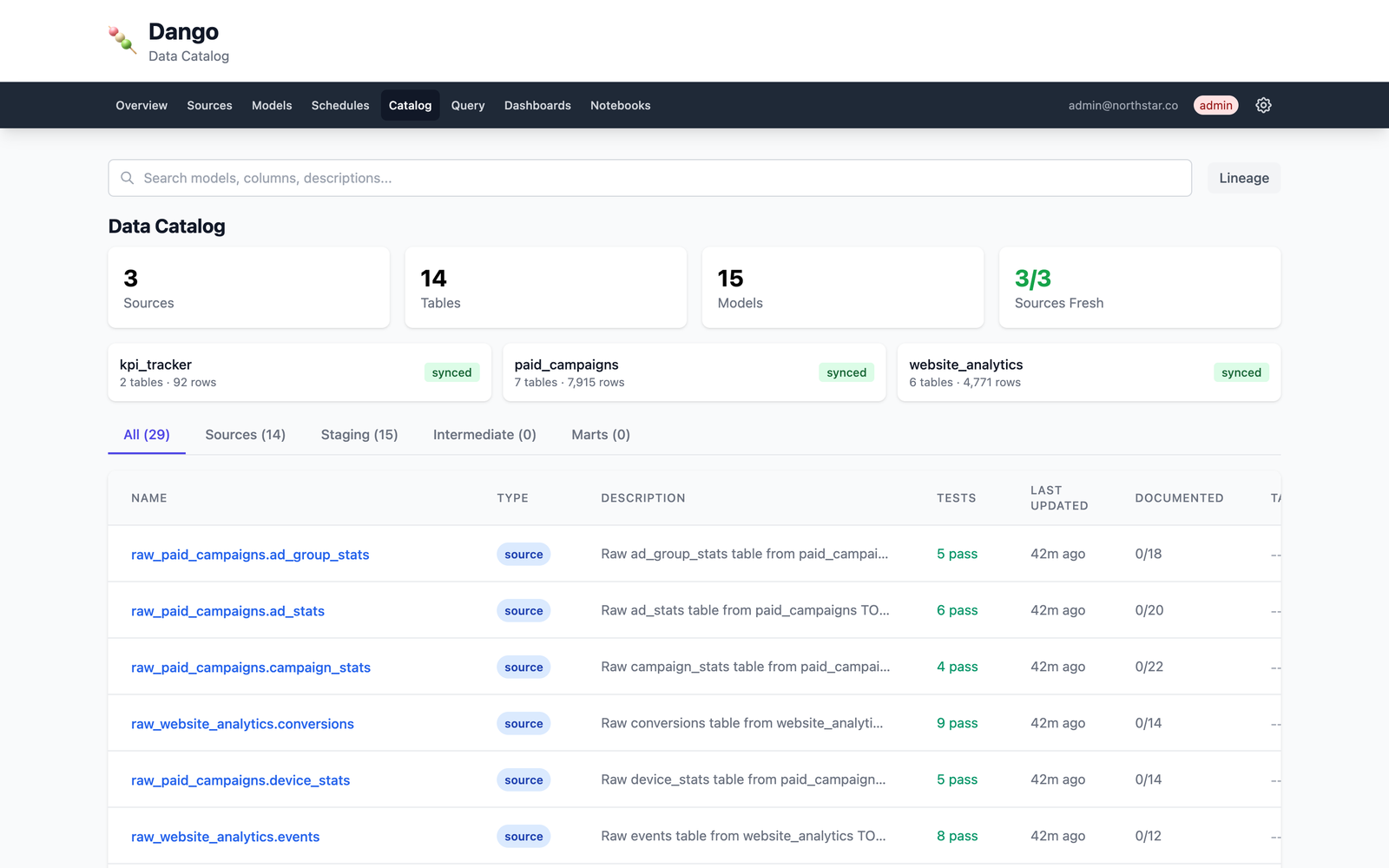
Data Catalog — browse tables, explore columns with profiling stats, view data lineage.
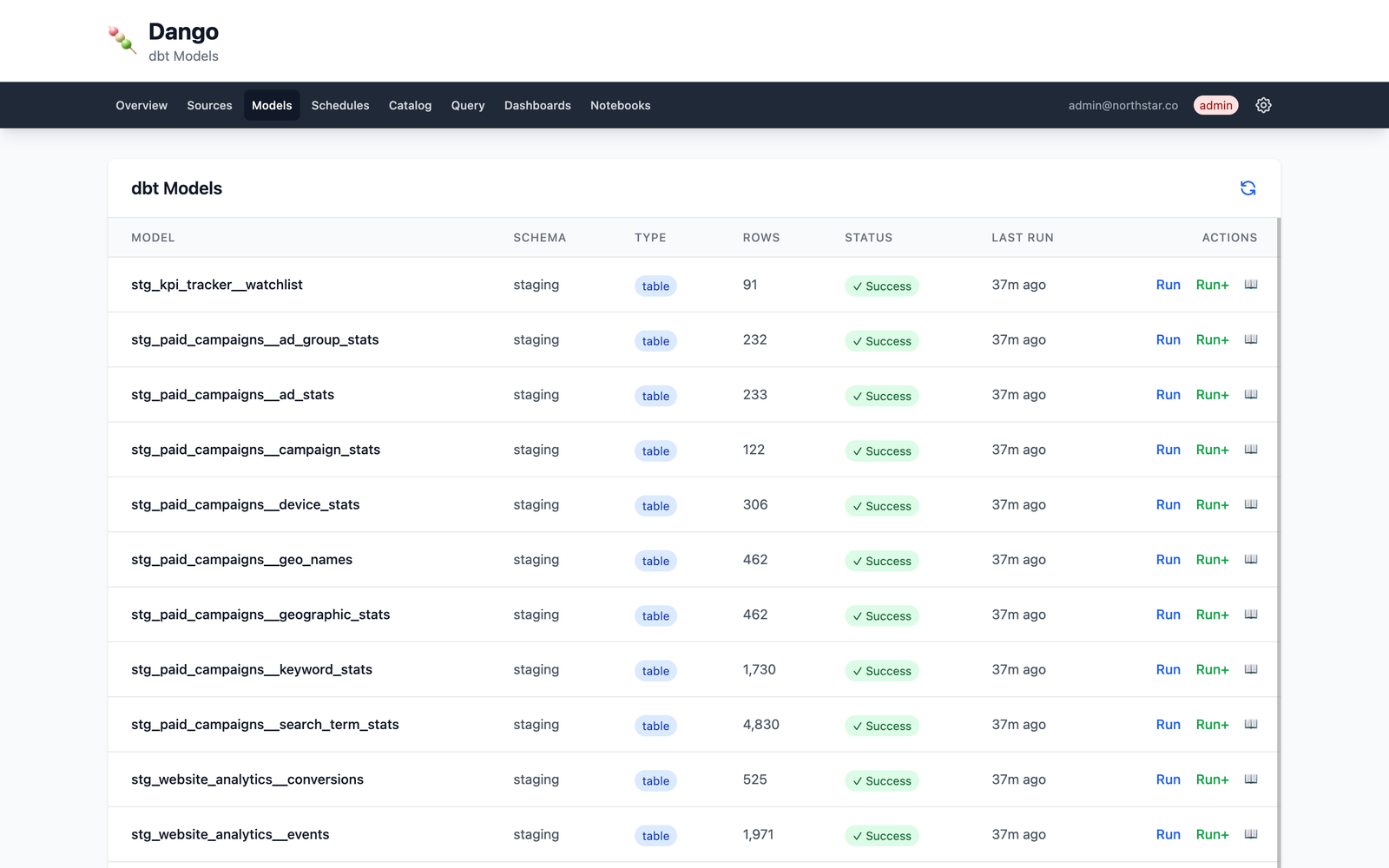
dbt Models — view model status, run transformations, and track test results.
Sources  →  dlt  →  DuckDB  →  dbt  →  Metabase
(APIs,       (load)  (warehouse) (transform) (dashboards)
 CSVs,
 databases)
All data stays local in DuckDB. No external warehouse needed.
| Component | Tool | Role |
|---|---|---|
| Ingestion | dlt | Load data from 35 sources |
| Warehouse | DuckDB | Embedded analytics database |
| Transformation | dbt | SQL modeling and testing |
| Dashboards | Metabase | BI and SQL queries |
| Web UI | FastAPI | Monitoring and management |
| Containers | Docker | Metabase and service orchestration |
Full documentation at docs.getdango.dev.
See CONTRIBUTING.md for development setup and guidelines.
Apache 2.0 — see LICENSE for details.
Dango is honest about what it doesn't do yet. The short version — full detail at docs.getdango.dev/reference/limitations:
- Single-writer concurrency until the Quack migration lands (DuckDB 2.0)
- No streaming, CDC, or reverse ETL
- 35 sources today, added on demand
- BYOS deployments need to configure their own backup destination (warned at deploy time)