
Every government-sponsored mass wedding in Nigeria over the past decade, plotted on the map and set against the things that explain them: how poor each state is, how many people live there, and how much money it gets from the federation account.
In August 2026 Kano married 1,500 couples in a single two-day ceremony and the story travelled the world as a curiosity. It isn't one. Northern state governments have been running these programmes every year for a decade: Kano, Katsina, Kebbi, Sokoto, Zamfara, Bauchi, Gombe, Jigawa. Usually through their Hisbah boards, usually paying the dowry, usually aimed at widows, divorcees and couples who cannot afford to marry. This map shows the whole pattern at once, and how sharply it stops at the middle belt.
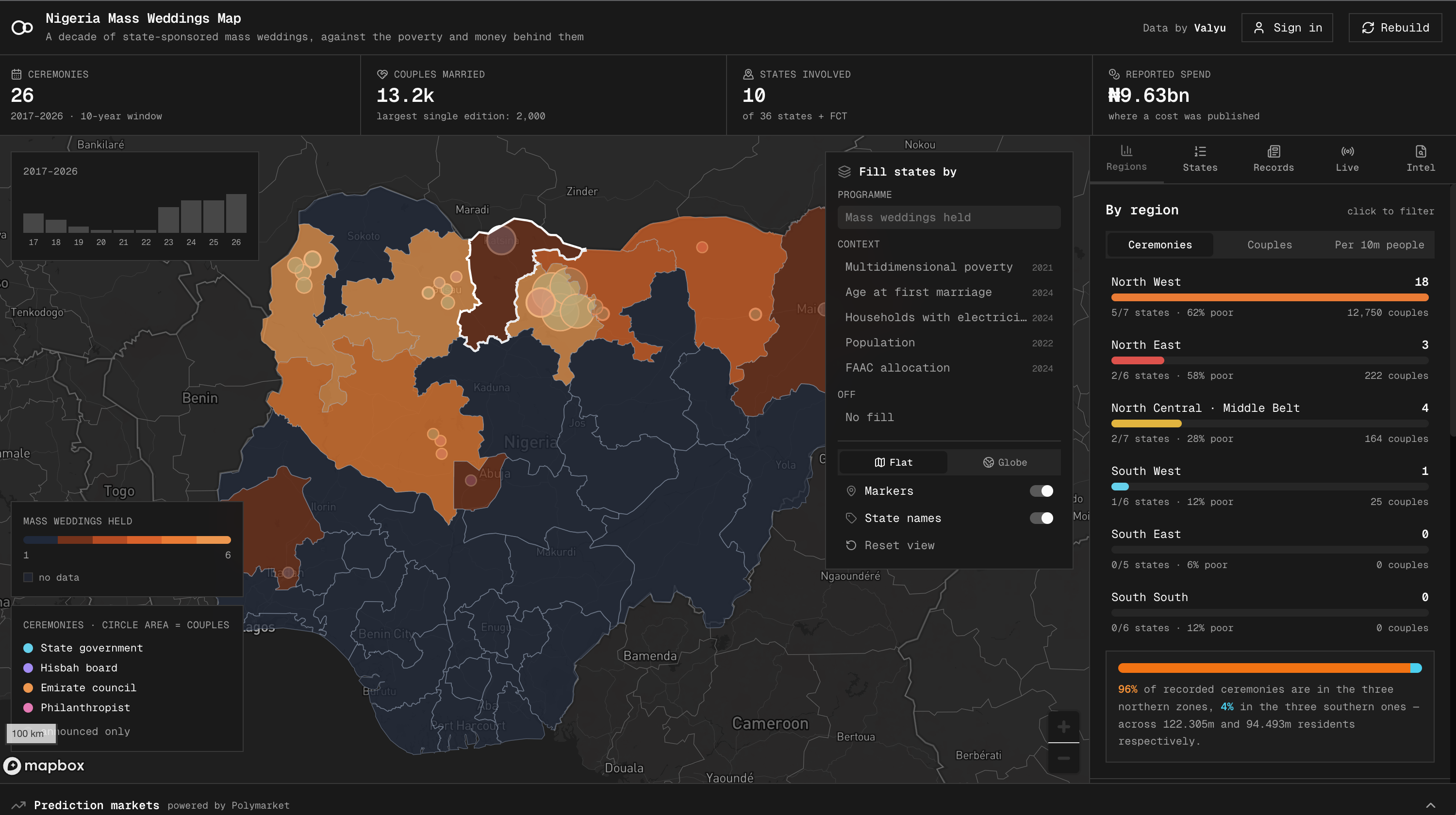
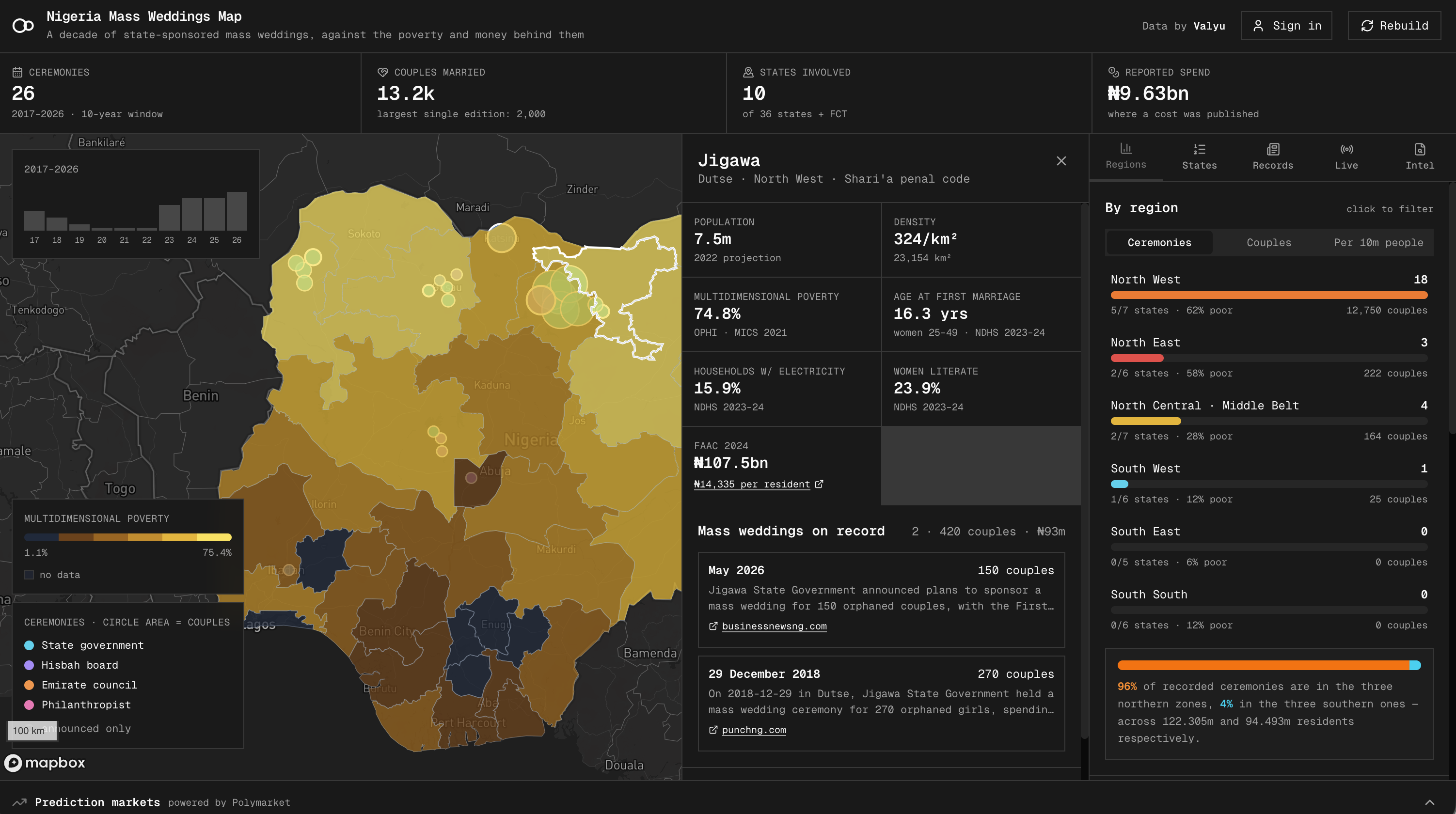
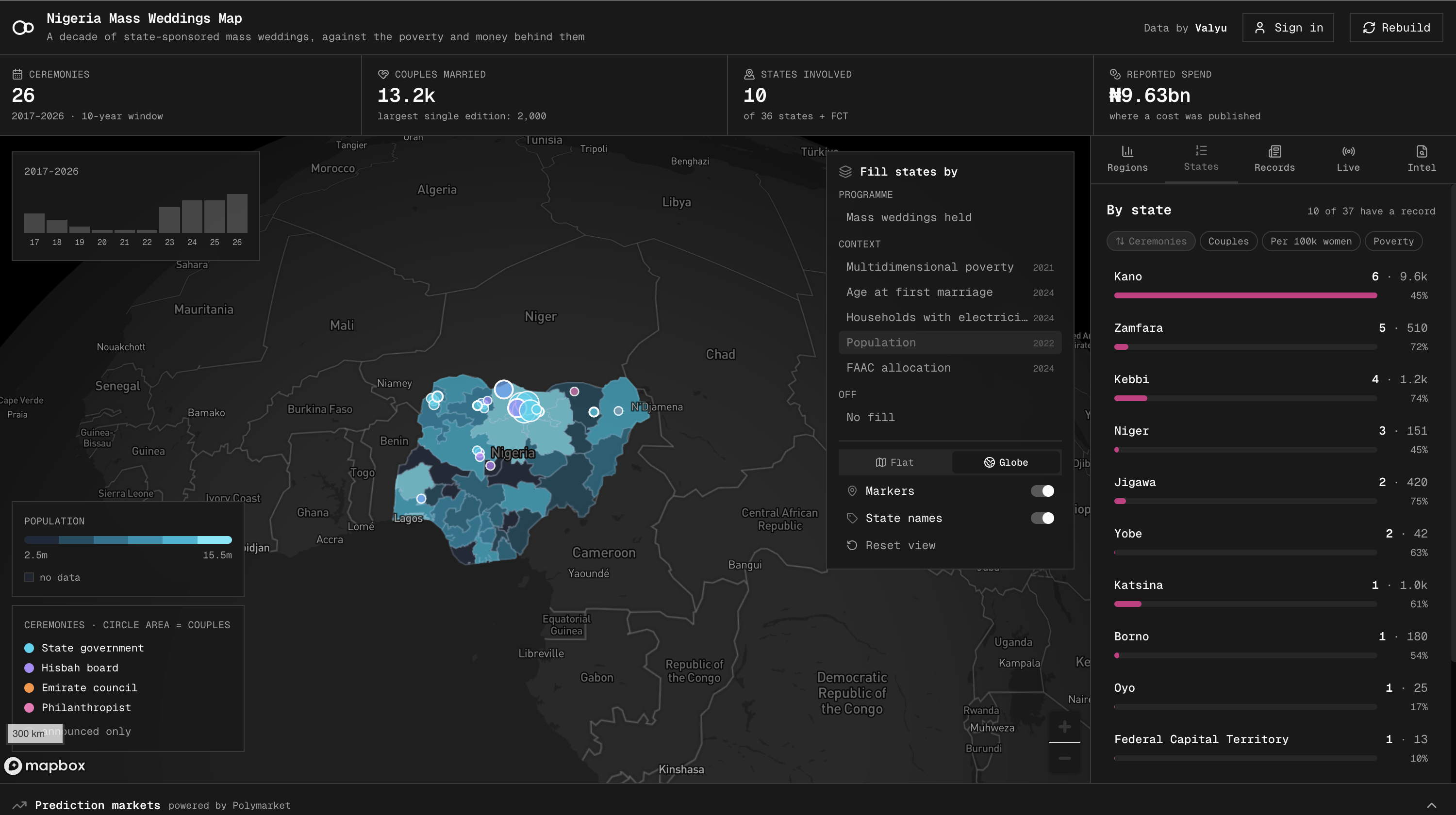
The map. Each circle is one ceremony, sized by the number of couples and coloured by who paid for it: state government, Hisbah board, emirate council, philanthropist. Circles outlined in white were announced but never confirmed as held. States are filled by whichever variable you pick: ceremonies held, multidimensional poverty, median age at first marriage, household electricity, population, or FAAC allocation, each labelled with the year of its source. Switching the fill from ceremonies to age at first marriage is the whole argument in one click: the states running these programmes are the states where women marry at 15 to 17.
Flat by default, with a globe projection a click away. For a single country at this zoom the globe curves the frame without adding information, so the flat view is the honest default. The toggle is there when you want Nigeria in its regional context.
Regions. A breakdown across the six geopolitical zones: North West, North East, North Central (Middle Belt), South West, South East and South South. Three views of each: raw ceremony counts, couples married, and ceremonies per 10 million residents, which strips out the effect of zone size.
States. A league table sortable by ceremonies, couples, couples per 100,000 women aged 15–29, or poverty rate, with the poverty figure printed next to each state so the correlation is visible rather than asserted. The panel reports the Pearson r across all 37 states.
A state's record. Click any state for its population, density, poverty rate and FAAC allocation, every ceremony on record with source links, and a Research with Valyu button that pulls a live, cited briefing on that state's programme history, including a plain "this state has never run one" where that is the answer.
The decade. A year-by-year bar of ceremony counts floating over the map, doubling as the time filter. Every year in the ten-year window gets a bar, including the empty ones, because a quiet year is information.
Live Feed. The last 90 days of Nigerian reporting on mass weddings, searched fresh rather than read from the cached dataset.
Intel. Free-form research on any state, Hisbah board, governor, programme or claim the map raises, with angle presets for programme history, spending, criticism and background. Answers come back cited.
Prediction markets. A Polymarket drawer along the bottom: Nigeria first, then Africa, then geopolitics. The story that started this map came off a Polymarket feed in the first place.
This is the part that matters. Nothing on this map is a figure that was invented to fill a gap.
| Layer | Source | Nature |
|---|---|---|
| Population, age & sex | UNFPA / NPC Common Operational Dataset (COD-PS), 2022 projection | Official dataset, read directly |
| Multidimensional poverty | OPHI, University of Oxford, Nigeria MPI from the 2021 MICS | Official dataset, read directly |
| Marriage age, electricity, literacy | Nigeria DHS 2023–24, NPC and ICF, via The DHS Program | Official dataset, read directly |
| State boundaries | geoBoundaries (GRID3 Nigeria state boundaries), CC BY 4.0 | Official dataset, read directly |
| FAAC allocations | NBS and outlets publishing NBS/BudgIT breakdowns, sourced through Valyu | Reported figures, each carrying its source URL |
| Mass wedding ceremonies | Nigerian and international news, searched through Valyu | Extracted from reporting, each carrying its sources |
Two deliberate choices:
- Unsourced means blank, not guessed. FAAC has no open machine-readable state-level dataset; NBS publishes monthly disbursements as report scans. Rather than estimate, the build script keeps only figures it can attach a URL to; the two states it could not source render as "no data". Same rule for couple counts: a ceremony reported without a number stays null rather than being filled in.
- The south is searched as hard as the north. A state with no ceremonies is a finding, and a finding is only worth anything if you looked. The query set gives every state a dedicated sweep, and the roundup pass runs over all 37. Read an empty state as nothing surfaced in the sources searched, not as proof nothing happened.
Population and poverty are regenerated straight from source with npm run build:reference, and the 2024 survey indicators with npm run build:dhs, so you can verify them yourself in one command.
On data vintages. The poverty index is from the 2021 MICS, and it is the most recent state-level MPI that exists; nobody has published one from the 2023–24 survey yet. Rather than pass a 2021 figure off as current, the map labels every layer with its year and adds three genuinely 2024 indicators from the NDHS alongside it. Population is the 2022 COD-PS for the same reason: there is no newer authoritative subnational dataset, only projections, and the projection is computed in the open rather than presented as a measurement.
lib/pipeline.ts, in four stages:
- Recall. Around 60 Valyu searches over the ten-year window: thematic queries, one per northern state, grouped sweeps of the south, and one per year across the window. A second pass is pinned to Nigerian outlets, which cover the smaller editions the wires ignore.
- Extraction. Each article goes to a structured-output model that returns state, town, date, couples, cost, dowry, sponsor, beneficiary group, and crucially whether the ceremony happened or was merely announced. Numbers are taken exactly as reported or left null.
- Roundup. Article search misses editions that were covered once in 2017 and never re-indexed, so Valyu is also asked to enumerate each state's history directly, against a schema that requires a source URL per entry.
- Collapse. Twenty outlets covering one ceremony must land as one dot. Records are bucketed by state and year, then clustered by couple count, with a ceremony that happened outranking an announcement and a precise date outranking a vague one. Sources are unioned onto the surviving record.
One subtlety worth knowing about: some outlets report the combined number of brides and grooms rather than couples: "3,600 brides and grooms" for a ceremony of 1,800 couples. Left alone that shows up as a second ceremony and doubles the year's total. Where one cluster in a state-year is roughly 2× another, the two are folded together, and the surviving count is the better-corroborated one rather than automatically the smaller.
The result is cached in data/weddings.json and served from there, so the map loads instantly. Rebuilding is explicit: the button in the header, or npm run seed.
The rebuild runs in stages (one article pass, then state batches) rather than one long request. A single call covering the whole pipeline outlives the HTTP client's timeout, and staging means a failure late in the run keeps everything already written.
Node 22+ and pnpm. Three services are involved, but only a Mapbox token is needed to see the app running, because the dataset ships with the repo.
- Mapbox → console.mapbox.com/account/access-tokens. Free tier is plenty. Required.
- Valyu → platform.valyu.ai. Powers every search, extraction and briefing. Signing up gives you $10 in free credits, no card required, which goes a long way here: the search stage of a full rebuild runs a little over a dollar. Required to rebuild the data, or to use Live Feed and Intel.
- OpenAI → platform.openai.com/api-keys. Used only when rebuilding, to turn articles into structured records. Strongly recommended.
What each one costs you if it is missing:
| Key | Needed? | What breaks without it |
|---|---|---|
NEXT_PUBLIC_MAPBOX_TOKEN |
Required | The map area shows a "token missing" notice. Every panel and chart still works. |
VALYU_API_KEY |
To rebuild or research | The committed dataset still renders. Rebuilding, the per-state briefings, Live Feed and Intel do not. |
OPENAI_API_KEY |
Recommended | Extraction falls back to keyword matching, which is much blunter and will miss ceremonies. Only matters when rebuilding. |
pnpm install
cp .env.example .env.local     # then fill in the keys below
npm run dev
That is enough to browse everything: the map loads from data/weddings.json, which is committed, so first paint needs no API calls at all.
# Required
NEXT_PUBLIC_MAPBOX_TOKEN=pk.your_token_here
VALYU_API_KEY=your_valyu_key_here

# Recommended: extraction quality when rebuilding the dataset
OPENAI_API_KEY=sk-your_key_here
OPENAI_MODEL=gpt-4.1-mini

# 'self-hosted' (default) runs everything on the key above.
# 'valyu' puts Live Feed, Intel and state briefings behind a sign-in. See below.
NEXT_PUBLIC_APP_MODE=self-hosted

# Deployment only
NEXT_PUBLIC_SITE_URL=https://your-domain          # absolute URL for share cards
ALLOW_REBUILD=true                                # only when intentionally refreshing data in production
NEXT_PUBLIC_SITE_URL matters more than it looks: Open Graph and Twitter both reject relative image URLs, so without it share cards render blank. On Railway the injected RAILWAY_PUBLIC_DOMAIN is used automatically; everywhere else set it explicitly. It falls back to http://localhost:3000 in development.
The map, the charts and every cached figure are open to anyone. The features that hit Valyu on demand — Live Feed, Intel and state briefings — can be put behind a sign-in so they run on the reader's own credits rather than yours. Set NEXT_PUBLIC_APP_MODE=valyu and add the OAuth block:
NEXT_PUBLIC_VALYU_AUTH_URL=https://auth.valyu.ai
NEXT_PUBLIC_VALYU_CLIENT_ID=your-oauth-client-id
VALYU_CLIENT_SECRET=your-oauth-client-secret
VALYU_APP_URL=https://platform.valyu.ai
NEXT_PUBLIC_REDIRECT_URI=http://localhost:3000/auth/valyu/callback
OAuth credentials are not self-serve: contact contact@valyu.ai. NEXT_PUBLIC_REDIRECT_URI must match the port you are actually serving on, or the callback lands on the wrong app; if next dev moves you to 3001 because 3000 is taken, update it. Left as self-hosted (the default), those two features use the server's own VALYU_API_KEY and no sign-in appears anywhere.
Everything below writes into data/ and is committed, so you only need these to refresh.
# Ceremonies: around 60 Valyu searches plus a per-state sweep. Several minutes.
# Needs the dev server running: it drives the same endpoint the Rebuild button hits.
npm run dev
npm run seed
SEED_URL=http://localhost:3001 npm run seed   # if dev picked another port

# Population + poverty, straight from HDX. No API key needed.
npm run build:reference

# 2024 survey indicators, straight from The DHS Program. No API key needed.
npm run build:dhs

# FAAC allocations via Valyu. Needs VALYU_API_KEY.
# The `--` is load-bearing: without it npm swallows the flag and you get a full
# rebuild instead of a gap fill.
npm run build:faac -- 2024
npm run build:faac -- 2024 --fill-gaps   # retry only the states still unsourced
Half of those need no credentials at all: build:reference and build:dhs pull
from open datasets on HDX and The DHS Program, so the population, poverty and
2024 survey figures can be re-derived from source for free.
npm run build && npm startRebuilds are enabled automatically in development. In production they are disabled by default:
set ALLOW_REBUILD=true only while intentionally refreshing the cached dataset, then remove it
again. Without that explicit opt-in, the Rebuild button stays hidden and POST /api/weddings
returns 403.
- Correlation is not cause. The r between poverty rate and ceremony count is descriptive. These programmes cluster in poor states, and they also cluster in states with Hisbah boards and a particular set of politics. The map shows where they happen; it does not tell you why.
- Coverage is uneven by design of the media, not of the map. Kano's editions are covered by the BBC and AP. A 200-couple ceremony in a Kebbi LGA gets one Daily Trust story. The dataset will always know more about the big northern editions than the small ones.
- Announced is not held. Programmes get budgeted, screened for, and quietly dropped. Those records are kept but marked, and can be filtered out.
- Couple counts are what was reported. Where a state reported brides and grooms separately, or where the announced figure differed from the figure on the day, the clustering keeps the most frequently reported number and links every source so you can check.
Next.js 16 · Mapbox GL + react-map-gl · Tailwind v4 · Zustand · Valyu for search, structured extraction and answers · zod