

Exploring how AI systems can reason more reliably — not just generate more tokens.


Research direction · Selected projects · Technical toolkit · Principles · Connect
I'm a computer science student focused on understanding how intelligent systems reason, plan, and solve difficult problems.
My primary long-term direction is AI reasoning research. I'm especially interested in hierarchical reasoning approaches, Hierarchical Reasoning Models (HRM), and deliberate, multi-step inference inspired by the System 2 idea.
Alongside that direction, I build software, interactive learning environments, and tools for AI-assisted engineering. I use projects to strengthen the fundamentals, test ideas, and make technical concepts easier to inspect.
The question that motivates me: How can we build AI systems that spend computation more thoughtfully, structure difficult problems better, and produce reasoning that can be evaluated rather than merely trusted?
What I'm exploring
| Area | Questions I'm interested in |
|---|---|
| Hierarchical reasoning | Can multi-level computation help a model decompose and solve problems that are difficult to handle in one pass? |
| System 2-inspired inference | When should a model pause, plan, verify, or use additional inference-time computation? |
| Reasoning evaluation | How do we measure correctness, robustness, consistency, and reasoning efficiency—not just answer length? |
| Compute and efficiency | What trade-offs exist between reasoning quality, inference cost, latency, and model size? |
| Experimental methodology | How can experiments be reproducible, baselines fair, and improvements supported by evidence? |
- Studying hierarchical reasoning architectures and the ideas behind HRM.
- Understanding deliberate, multi-step inference and inference-time computation.
- Building stronger foundations in neural networks, deep learning, and optimization.
- Learning how to design useful reasoning benchmarks, ablations, and evaluations.
- Comparing systems using measurable outcomes instead of relying on impressive-looking examples.
This is an evolving research direction. I share projects and experiments as I build the knowledge and evidence behind them.
My repositories cover different parts of the engineering journey—from understanding neural networks to building reusable AI-agent workflows. They are supporting projects around my broader interest in intelligent systems, not claims of completed research results.
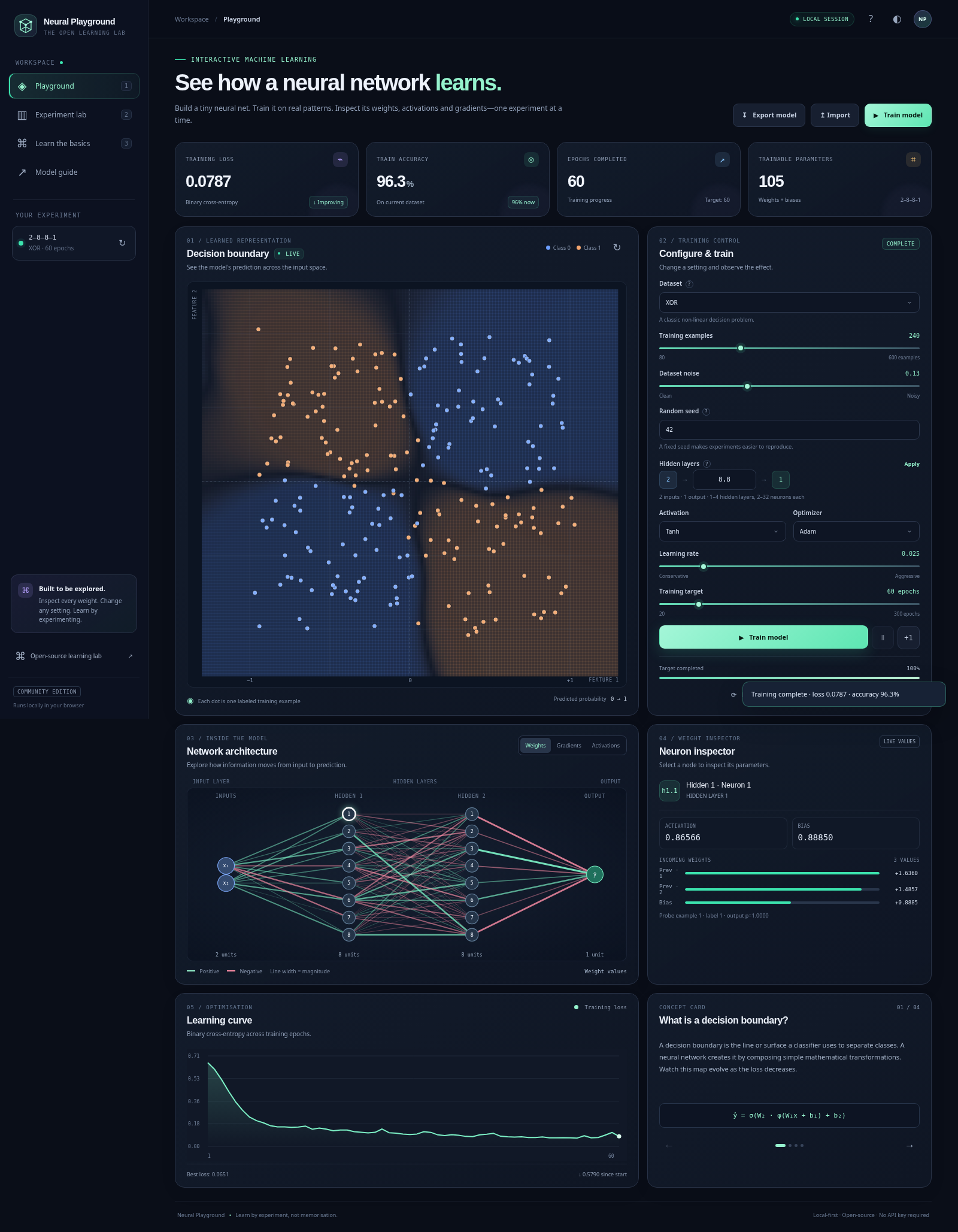
Learn by seeing the network learn.
An interactive lab for building, training, and inspecting small neural networks.
- Train small multilayer perceptrons and explore decision boundaries.
- Inspect weights, activations, and gradients.
- Compare optimizers and experiment with training behavior.
- Includes a NumPy and Matplotlib experiment track.


Equip your agents. Raise the standard.
An open-source field kit of 25 evidence-first workflows for software engineering, security, AI/ML research, and multi-agent collaboration.
- Reusable workflows for engineering, testing, review, and security.
- AI/ML research and evaluation-oriented workflows.
- Portable skill content designed to work across multiple agent environments.


Give your AI coding workflow a crew. Not more chaos.
A spec-first development toolkit for Codex CLI, with portable skill workflows for ChatGPT.
- 23 reusable skills for discovery, specification, implementation, testing, and review.
- 10 specialist Codex agent profiles.
- Structured workflows that emphasize clear scope, verification, and evidence.


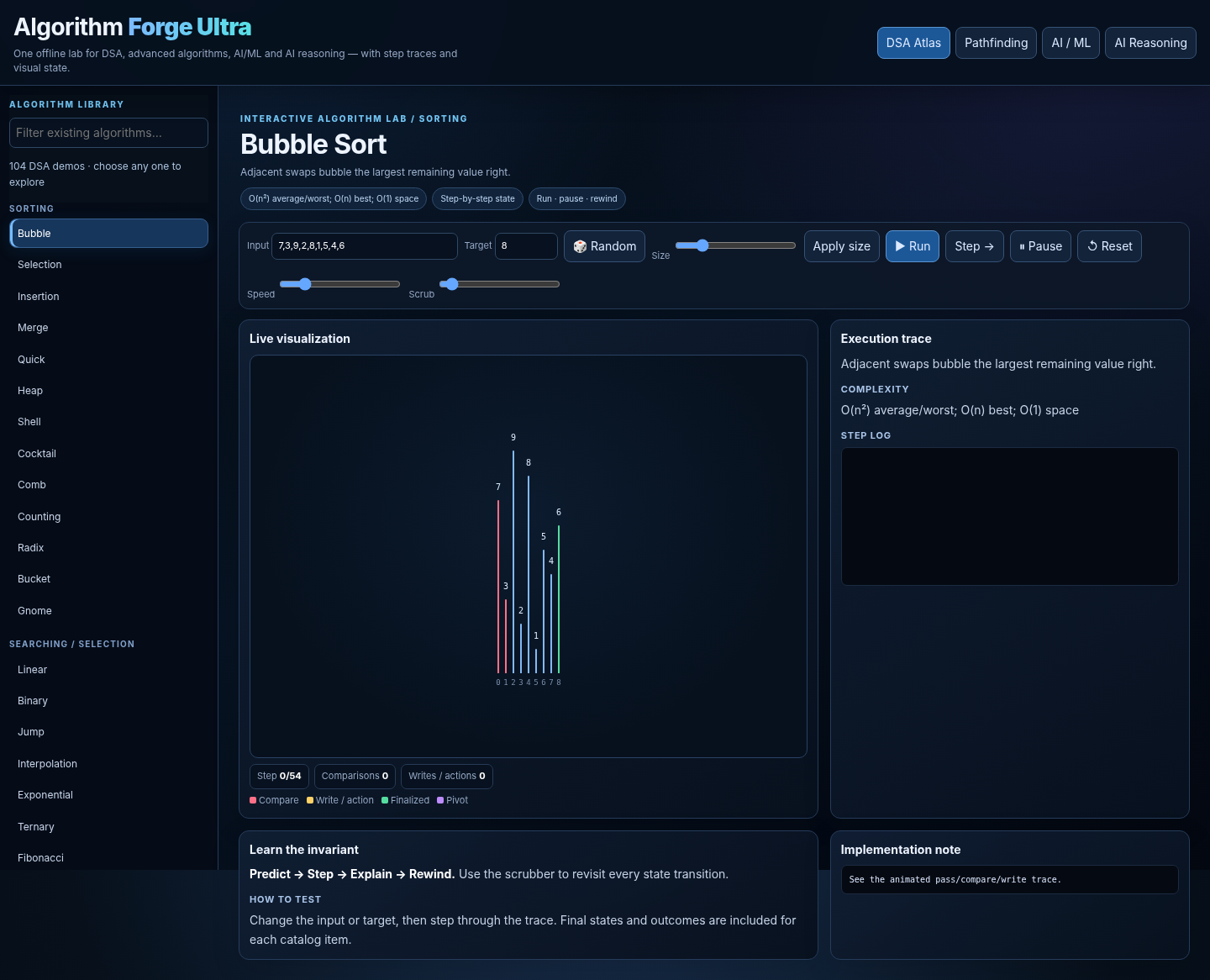
Don't just study algorithms. Watch them work.
An interactive browser-based learning environment with 129 demonstrations across data structures and algorithms, pathfinding, AI/ML, and reasoning.
- Step-by-step execution, playback controls, and editable inputs.
- Explore algorithm behavior through visual experiments.
- Runs as a static browser application.

Explore the rest of my project portfolio
| Project | What it explores | Links |
|---|---|---|
| Claude Garage | A Claude Code plugin with specialist agents and structured development workflows. | Repository · Interactive site |
| StudyOS | A local-first study workspace for planning, focus sessions, revision, notes, and analytics. | Repository · Live demo |
| CampusFlow | A student-built attendance prototype with rotating QR check-ins, SQLite, and CSV reports. Uses fictional demo data only. | Repository · Live demo |
| Pathfinding Forge | A visual playground for BFS, DFS, Dijkstra's algorithm, and A* search. | Repository · Live demo |
| BundleSleuth | A local-first macOS utility for inspecting selected domain strings in Claude Code bundles. | Repository |
Languages, libraries, and tools
Languages


AI/ML and data


Development


- Understand before optimizing. Establish the problem, assumptions, and baseline first.
- Measure, don't assume. Prefer reproducible experiments and meaningful evaluation over impressive demos.
- Build in small, verifiable steps. Keep projects understandable, testable, and maintainable.
- Be precise about evidence. Distinguish working prototypes, experiments, and established results.
- Share useful work. Document decisions and make tools accessible to others.
Open live GitHub statistics
Stats are generated by third-party services and may occasionally be unavailable or rate-limited.
I'm interested in thoughtful discussions around AI reasoning, hierarchical approaches, model evaluation, AI/ML experimentation, and open-source engineering.
The best way to connect through this profile is to explore a repository, open an issue with a concrete question, or start a discussion around an idea.

